

The 4Cs of Diamonds: Cut, Colour, Clarity & Carat Explained
Last updated July 2026
Whether you're shopping lab-grown or mined, the 4Cs are the framework every serious comparison comes back to. Developed by GIA and now used, with some genuine differences in how it's applied, across every major grading lab, understanding what each C actually measures is the difference between buying by gut feel and buying with real confidence.
What Are the 4Cs?
Cut, colour, clarity and carat weight. Assessed together by labs like IGI and GIA, they determine a diamond's appearance, light performance and value. None of them work in isolation, which is really the central point of this guide: understanding how they trade off against each other matters more than memorising any single scale.
1. Cut: The Factor That Actually Drives Sparkle
Carat gets the attention, but cut is what most affects brilliance and fire. A colourless, flawless diamond cut poorly will still look flat and lifeless.
Cut assesses:
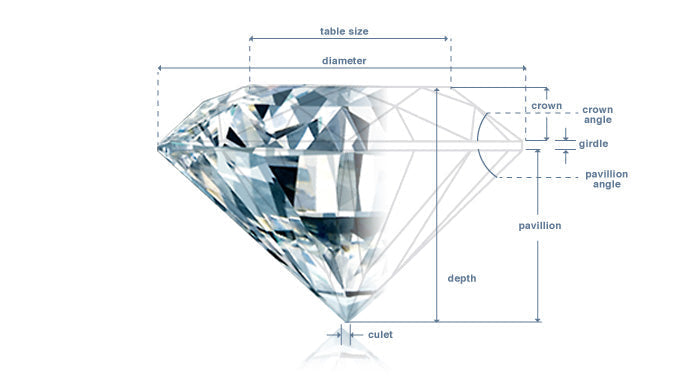
- Proportions — how each facet is angled and sized relative to the others
- Symmetry — how precisely the facets align
- Polish — the smoothness of each facet's surface
- Light performance — how effectively light reflects and refracts back to the eye
Cut grades (round diamonds only): Excellent, Very Good, Good, Fair, Poor.
Fancy shapes, oval, pear, radiant, marquise and others, don't currently receive this same overall cut grade from GIA. IGI does grade cut for several fancy shapes, and for any shape without a formal cut grade, proportions and the polish/symmetry grades matter considerably more when comparing stones. We've gone into this in full detail in our diamond proportions guide.
💎 Experience clean-cut sparkle in the Elysian Oval Solitaire Ring.
2. Colour: The Whiter, the Rarer, Usually
Diamond colour measures how close to colourless a stone is; the less colour, the higher the grade.
GIA colour scale:
- D–F: Colourless
- G–J: Near Colourless
- K–M: Faint
- N–R: Very Light
- S–Z: Light
Most high-quality lab-grown diamonds fall in the D to F range. Plenty of clients deliberately choose a warmer G to J grade, particularly for vintage-style pieces or yellow gold settings, where the metal tone already carries warmth and a slightly warmer stone reads as intentional rather than compromised.
Fancy colour diamonds (pink, yellow, blue and beyond) are graded on an entirely separate hue, tone and saturation system, not the D-to-Z scale. We've covered that in depth in our coloured lab-grown diamonds guide.
3. Clarity: Natural and Grown-In Characteristics
Clarity describes internal inclusions and external blemishes, features that form naturally during a diamond's formation, whether that's underground over billions of years or in a growth chamber over several weeks.
Clarity scale, highest to lowest:
- FL — Flawless
- IF — Internally Flawless
- VVS1 / VVS2 — Very, Very Slightly Included
- VS1 / VS2 — Very Slightly Included
- SI1 / SI2 — Slightly Included
- I1–I3 — Included, typically visible without magnification
Most lab-grown diamonds we see fall in the VS1 to VVS1 range, eye-clean, with inclusions that are minimal or invisible without magnification. Clarity carries more visual weight in larger stones and in step cuts like emerald, where large open facets make internal characteristics easier to spot than in a round brilliant's more fragmented light pattern.
4. Carat: Weight, Not Size
Carat measures weight, not physical dimensions. One carat equals 0.2 grams. Larger stones are rarer and command a price premium, but carat alone says nothing about how a diamond actually looks. A poorly cut 1.2ct diamond can genuinely appear smaller than a well-cut 1.0ct.
| Carat | Approx. Diameter (Round Brilliant) |
|---|---|
| 0.50 | ~5.2 mm |
| 1.00 | ~6.5 mm |
| 2.00 | ~8.2 mm |
| 3.00 | ~9.4 mm |
These are approximate, actual diameter shifts with depth and cut proportions, which is exactly why cut and carat need to be read together rather than carat weight alone.
How the 4Cs Work Together
They're not independent factors, they're a system, and trade-offs are where most of the real decision-making happens:
- A lower-carat diamond with an excellent cut can genuinely look larger than a heavier, poorly cut stone
- A VS2 clarity diamond can appear entirely flawless to the eye if its inclusions are small and well positioned
- A G colour diamond can read just as white as a D colour once mounted, particularly in yellow or rose gold
We help clients weigh these trade-offs against personal priorities and budget at every consultation, there's rarely one objectively "correct" balance, only the right one for what you actually want to see on your hand.
Lab-Grown Diamonds and the 4Cs
Lab-grown diamonds are assessed on the exact same 4Cs framework as mined diamonds. One current nuance worth knowing: since October 2025, GIA grades lab-grown diamonds using a simplified Premium or Standard quality tier rather than the specific letter-and-number grades described above, while IGI continues to issue full 4Cs grading for lab-grown stones. Neither approach changes the underlying quality of the diamond, it just changes what the certificate shows you. Full detail is in our lab-grown certification guide and our guide to reading an IGI certificate.
What's genuinely true of lab-grown diamonds:
- Frequently higher clarity and colour grades, a result of the controlled growing environment, see our piece on how lab-grown diamonds are made
- Considerably better value per carat than a comparable mined stone
- Full 4Cs transparency and certification through IGI or GIA
- A fully traceable origin, with environmental impact depending on the individual producer's energy source rather than being uniformly lower across the board
One more attribute worth knowing about, though it's not one of the 4Cs: fluorescence. It doesn't factor into grade or the four core criteria, but it's disclosed on the certificate and worth understanding, we've covered it fully in our diamond fluorescence guide.
Know Before You Buy
Understanding the 4Cs means you're choosing a diamond based on what actually matters to you, sparkle, size, budget or brilliance, rather than defaulting to carat weight or price tag as a proxy for quality. They're a system, not a checklist, and the right balance is genuinely personal.
How We Help You Balance the 4Cs at VYOR Diamond Lab
Nikolett and I walk every client through these trade-offs directly, showing you how cut, colour, clarity and carat actually look and perform on real stones, not just as numbers on a certificate. Whether you're prioritising a bigger centre stone or chasing the last percentage point of cut precision, that's exactly the conversation a showroom consultation is for.
Frequently Asked Questions
Which of the 4Cs matters most? Cut, generally. It has the biggest impact on visible brilliance and fire, and a well-cut diamond can outperform a larger or higher-clarity stone that's poorly proportioned.
What's the difference between a D colour and a G colour diamond? D is completely colourless, the highest grade. G is near-colourless and can appear equally white to the eye once mounted, particularly in warmer metal settings, at a noticeably lower price.
Do lab-grown diamonds get graded on the same 4Cs as mined diamonds? Yes, largely. IGI grades lab-grown diamonds on the full 4Cs scale. Since October 2025, GIA uses a simplified Premium/Standard system for lab-grown diamonds instead of specific letter-and-number grades.
Is a flawless (FL) diamond worth the premium over VVS or VS? For most buyers, no, VS1 and above are typically eye-clean, meaning inclusions aren't visible without magnification. FL and IF grades carry a real premium for a difference that's rarely visible to the naked eye.
Does carat weight determine how big a diamond looks? Not on its own. Cut and depth affect face-up size significantly, a well-cut diamond can look larger than its carat weight suggests, and a poorly cut one can look smaller.
Explore our Lab-Grown Diamond Engagement Ring Collection, or book a consultation at our Wembley showroom to see the 4Cs in person.
Share:
Lab-Grown vs Mined Diamonds: Who Actually Wins? A Scorecard
How to Read an IGI Diamond Certificate: A Section-by-Section Guide