

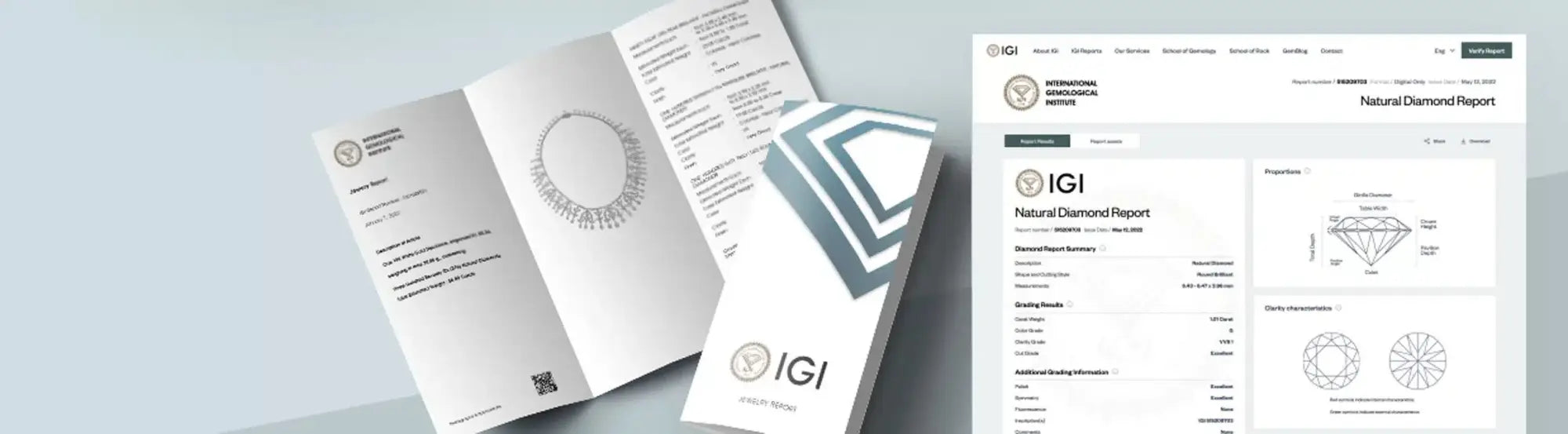
Lab-Grown Diamond Certification: What an IGI or GIA Report Actually Tells You
Last updated July 2026
If you're comparing lab-grown diamonds, you'll see two letters everywhere: IGI and GIA. Almost every retailer name-drops one or both, but very few explain what the certificate in front of you is actually verifying, or why the two labs no longer grade lab-grown stones the same way.
That last point matters more than it used to. In October 2025, GIA changed how it grades lab-grown diamonds entirely, and a lot of certification guides online still haven't caught up. Here's what a lab-grown diamond certificate covers, how IGI and GIA differ today, and what to check before you commit to a stone.
What Is a Lab-Grown Diamond Certificate?
A diamond certificate, sometimes called a grading report, is an independent assessment carried out by a gemological laboratory with no financial interest in the sale. It exists to answer one question honestly: what is this stone, and how good is it?
A proper certificate confirms:
- Origin — natural or laboratory-grown, and if lab-grown, the growth method (HPHT or CVD)
- The 4Cs — cut, colour, clarity and carat weight, assessed under controlled lighting and magnification
- Proportions and finish — measurements, polish and symmetry
- A unique report number, usually laser-inscribed on the girdle of the diamond itself, so the certificate and the physical stone can always be matched
Without one, you're taking the seller's word for it. With one, you can check the claims independently, any time, through the issuing lab's own database.
IGI Certification: The Standard for Lab-Grown Diamonds
The International Gemological Institute (IGI), founded in 1975, began grading lab-grown diamonds in 2005 and has graded the majority of the world's lab-grown supply ever since. It's ISO 17025 accredited for both natural and lab-grown diamond grading, which is the international standard for testing and calibration competence.
An IGI Laboratory Grown Diamond Report (identifiable by its yellow cover, distinct from the standard white natural-diamond report) includes:
- Individual grades across the full 4Cs, using the same D-to-Z colour scale and Flawless-to-I3 clarity scale applied to natural diamonds
- Cut grade, polish and symmetry
- Growth method (HPHT or CVD), noted where disclosed
- A laser inscription on the girdle stating the report number and the words "Laboratory Grown," visible only under magnification and invisible to the naked eye
Because IGI applies the full 4Cs grading scale to lab-grown stones, it remains the most detailed and directly comparable certification available for them — which is exactly why the bulk of the lab-grown market is graded there.
GIA Certification: What Changed in October 2025
The Gemological Institute of America (GIA), founded in 1931, is the lab that originally developed the 4Cs framework and remains the benchmark for natural diamond grading. Its involvement with lab-grown diamonds has shifted several times over the years, but the most significant change came into effect on 1 October 2025.
GIA now grades lab-grown diamonds on a simplified two-tier system rather than the detailed 4Cs scale:
- Premium — requires D colour, VVS clarity or higher, excellent polish and symmetry, and (for round brilliants) an excellent cut grade
- Standard — E to J colour, VS clarity, very good polish and symmetry, and at least a very good cut grade for round brilliants
- Stones that don't meet the Standard threshold receive no GIA report at all
GIA's stated reasoning is that over 95% of lab-grown diamonds already fall within a narrow band of high colour and clarity, so a granular letter-and-number grade adds little practical distinction. The trade-off is that two "Premium" diamonds from different sellers could still vary slightly in colour or clarity without that showing on the certificate, since the report groups them rather than pinpointing them.
Every GIA-assessed lab-grown diamond still receives a laser inscription reading "Laboratory-Grown" with its report number, and GIA has confirmed that all previously issued detailed 4Cs reports for lab-grown diamonds remain valid.
IGI vs GIA for Lab-Grown Diamonds: The Real Difference Now
| IGI | GIA (post-Oct 2025) | |
|---|---|---|
| Grading detail | Full 4Cs, letter/number grades | Two-tier: Premium or Standard |
| Colour & clarity | Specific grade (e.g. F, VS1) | Grouped range only |
| Market share for lab-grown | Majority of global supply | Smaller, shifting focus to natural |
| Best for | Comparing specific stones side by side | Confirming a stone meets a defined quality bar |
| Laser inscription | Report number + "Laboratory Grown" | Report number + "Laboratory-Grown" |
Neither lab is "better" in an absolute sense; they're now answering slightly different questions. If you want to compare two specific diamonds on exact colour and clarity, an IGI report gives you the detail to do that. If you want confirmation that a stone clears a defined, independently verified quality threshold, a GIA Premium or Standard assessment does that job too, just with less granularity.
How VYOR Diamond Lab Certifies Our Diamonds
Every lab-grown diamond at VYOR Diamond Lab is certified by IGI or GIA. We don't limit our sourcing to one lab, because doing so would mean turning away exceptional stones purely over paperwork format rather than quality. Nikolett and I review each stone's certificate personally as part of sourcing, and we're always upfront with clients about which lab issued the report and what that report does and doesn't specify.
Our moissanite is a different gemstone entirely, so it isn't IGI or GIA graded (neither lab certifies moissanite). Every moissanite stone we set is D colour, VVS1 clarity, and comes with a VYOR Diamond Lab Certificate of Authenticity confirming its grade and ethical sourcing.
How to Verify a Diamond Certificate Yourself
Before you finalise a purchase anywhere, not just with us, you can check a certificate independently:
- Take the report number printed on the certificate
- Visit the issuing lab's official verification page — igi.org or gia.edu
- Enter the report number
- Confirm the details match what's on the physical certificate and what you were told about the stone
This takes under a minute and it's the single best way to know a certificate is genuine rather than a print-out.
Frequently Asked Questions
Is IGI or GIA better for a lab-grown diamond? Neither is objectively better since October 2025's changes. IGI gives a specific 4Cs grade; GIA gives a Premium or Standard quality tier. Choose based on whether you want granular comparison detail or a simpler quality benchmark.
Do lab-grown diamonds need certification? Yes. Without independent certification, there's no third-party confirmation of the stone's origin, quality or authenticity, and no way to verify it later for insurance or resale purposes.
Can I verify a lab-grown diamond certificate online? Yes. Both IGI and GIA offer free online verification using the report number found on the certificate.
Does GIA still grade lab-grown diamonds using the 4Cs? No, not since 1 October 2025. GIA now uses a two-tier Premium/Standard system for lab-grown diamonds. Reports issued before that date under the old 4Cs format remain valid.
Is moissanite IGI or GIA certified? No. Moissanite is a distinct gemstone, not a diamond, so neither lab grades it. Reputable jewellers issue their own Certificate of Authenticity instead.
Where can I see IGI or GIA certified lab-grown diamonds in Perth? At our Wembley showroom, by appointment. Every stone we present is shown alongside its certificate so you can review and verify it in person before making a decision.
Explore our Lab-Grown Diamond Engagement Ring Collection, or book a consultation at our Wembley showroom to compare certified stones side by side.
Share:
What is Diamond Fluorescence?
Lab-Grown vs Mined Diamonds: The Real Differences in 2026