

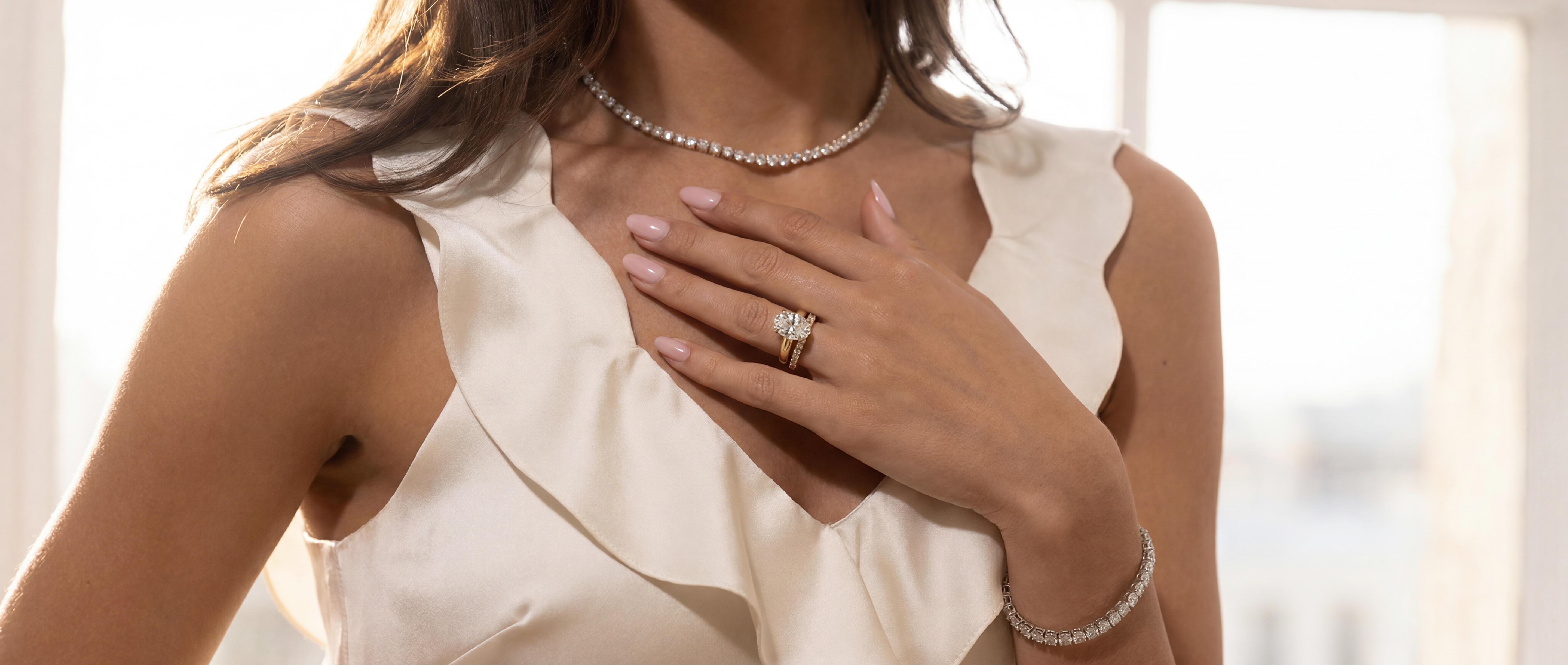
Lab-Grown Diamond Engagement Ring Cost in Australia (2026)
Last updated July 2026
Of all the questions we're asked, this is the one people are most nervous to say out loud: what does a lab-grown diamond engagement ring actually cost? It's a fair question with a genuinely frustrating honest answer, "it depends", and most price guides online are quietly out of date. The lab-grown market has moved faster in the last three years than the diamond world moved in the previous thirty. Here's a current, jargon-free picture of what to expect in Australia in 2026, and where your money does and doesn't make a real difference.
Why There's No Single "Lab Diamond Price"
A diamond isn't a commodity like a litre of fuel. Two stones of identical carat weight can differ by thousands of dollars, because four separate qualities are being priced simultaneously, the 4Cs: cut, colour, clarity, and carat. On top of the stone sits the ring itself: metal, setting style, and design work. Anyone offering a single tidy number with no questions asked is either guessing or leaving something out. A real price comes from a real conversation about what you actually want on your hand.
The Four Things That Actually Move the Number
Carat weight is the obvious driver, but here's what most guides skip: price doesn't rise in a straight line with size. A 2-carat diamond costs considerably more than two 1-carat diamonds of equal quality combined, because larger clean rough is genuinely harder to grow. There are also "magic weights," 1.00ct, 1.50ct, 2.00ct, where prices jump sharply purely due to buyer demand for the round number. A 1.90ct stone can be noticeably better value than a 2.00ct that looks all but identical on the finger.
Cut is where money is either well spent or quietly wasted, and it's the one C worth never compromising on. It governs how light travels into the stone and returns to the eye, brilliance and fire. A superbly cut diamond looks larger and livelier than its weight suggests; a poorly cut one of the same carat can look dull, dark, or glassy, and in elongated shapes can show a heavy bow-tie shadow across the centre. Same paperwork, genuinely different beauty.
Colour and clarity are where sensible savings live. Most buyers are happiest in the near-colourless range, no visible tint once set in white metal, at an eye-clean clarity, inclusions invisible without magnification. Chasing the very top of both scales, flawless clarity, top colour, adds real cost for distinctions genuinely invisible without a loupe and a trained eye.
A Rough Price Guide by Carat (2026, AUD)
These ranges assume a well-cut, near-colourless, eye-clean lab-grown diamond set in quality 18ct gold or platinum, a finished ring price, not the loose stone alone:
- 1 carat ring: from $4,000
- 1.5 carat ring: from $5,000
- 2 carat ring: from $6,500
- 3 carat ring: from $8,000
For context, a mined diamond of the same specification would typically cost several times more. That gap, the same look and gemological properties for a fraction of the spend, is the single biggest reason Australian couples have shifted toward lab-grown.
To see what's available at these price points, browse our lab-grown diamond engagement rings — or if you're open to moissanite as a way to maximise size and cut quality within budget, explore our moissanite engagement rings.
Why Lab-Grown Prices Have Fallen So Much
If you researched this even two or three years ago, current prices will genuinely surprise you. Growing technology matured, global production capacity expanded considerably, and supply began outpacing demand. Both major growth methods, CVD and HPHT, became cheaper and more reliable to run at scale. The result: the same size and quality lab-grown diamond costs meaningfully less now than it did recently. Wonderful news for buyers, and exactly why old price guides genuinely mislead, always work from current figures, not something read a couple of years ago.
Where Your Budget Goes Furthest
If there's one rule worth following: buy the best cut you can afford, then balance everything else to taste. A brilliantly cut 1.5 carat stone will almost always outperform a larger but lazily cut 1.8, both in sparkle and in how large it reads on the finger. After cut, choose colour and clarity that look flawless to your own eye rather than chasing a certificate's top tier, and redirect the saving into either size or a setting you'll genuinely love. On settings, a hidden halo, pavé band, or intricate gallery detail all add to the total, worth deciding early whether your priority is the stone, the design, or a genuine balance of both.
A few styles that illustrate the range well: the Mirella Oval Twisted Pavé, the Solara Grande Elongated Cushion Half-Bezel, and the Lyra East-West Oval Half Bezel. For something available without a custom lead time, see our ready-to-ship engagement rings.
A Few Costs People Forget
Beyond the ring itself, budget a little for insurance, either a standalone jewellery policy or an addition to home contents cover. Resizing, while usually straightforward, is a genuine service rather than a universal freebie everywhere. A reputable jeweller will also provide the diamond's IGI or GIA certificate, keep it safe, since it's exactly what an insurer or future valuer will want to see.
Frequently Asked Questions
Are lab-grown diamonds cheaper than mined diamonds?
Yes, significantly, typically a fraction of the price for the same carat, cut, colour, and clarity, since they're chemically and optically identical, you're paying far less for the same visible result.
Why are lab-grown diamond prices dropping?
Growing capacity and technology have expanded rapidly, so supply has scaled and per-carat prices have come down. A buyer today gets more diamond for the same budget than one from just a couple of years ago.
How much should I spend on an engagement ring?
There's no real rule, the old "two or three months' salary" guidance was advertising, not financial or gemological wisdom. Set a figure you're genuinely comfortable with, then prioritise cut quality so the ring performs at its best whatever size you choose.
Does a bigger lab-grown diamond always cost proportionally more?
No, price rises faster than size, with jumps at "magic weights" like 1.00 and 2.00 carat. Going slightly under a round number can be noticeably better value for a near-identical look.
Can I see lab-grown diamonds in person before buying in Australia?
Yes. Private showroom appointments are available in Perth, where you can compare stones and designs directly with the jeweller before deciding.
Ready to see real figures for your specific design? Book a consultation at our Wembley showroom or online.
Share:
Buying a Lab-Grown Diamond Engagement Ring in Perth