

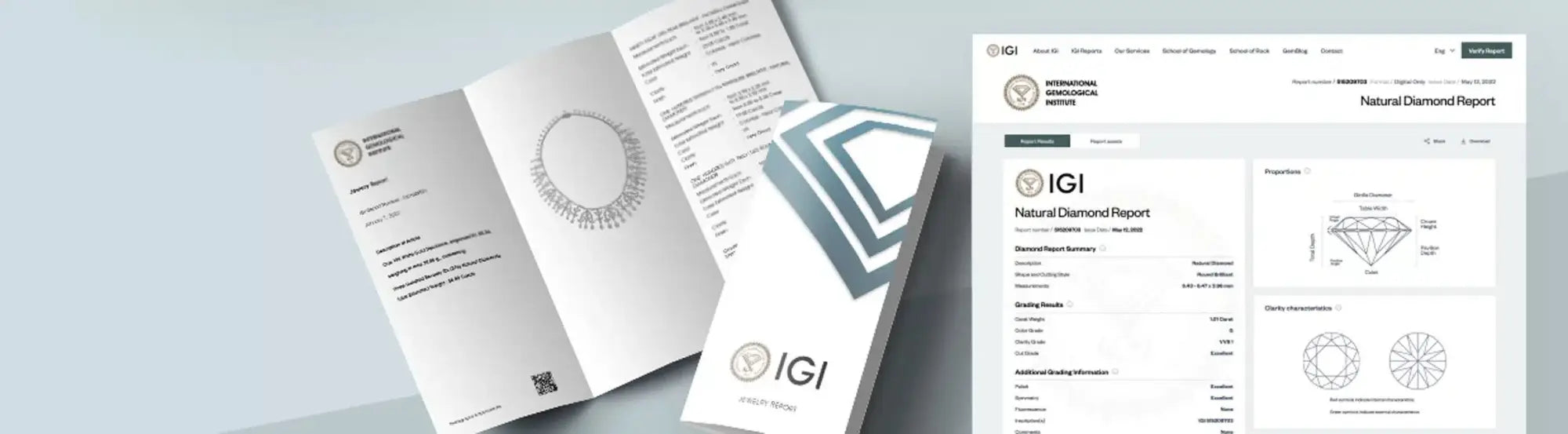
How to Read an IGI Diamond Certificate: A Section-by-Section Guide
Last updated July 2026
An IGI certificate is the single most important document you'll receive with a lab-grown diamond, but between the codes, percentages and diagrams, it isn't always obvious what you're actually looking at. Here's every section explained, what to check, and what genuinely matters when comparing two reports side by side.
What Is IGI and Why It Matters
The International Gemological Institute (IGI) is the world's leading grading authority for lab-grown diamonds, having graded lab-created stones since 2005 and now handling the majority of the global lab-grown supply. We source almost exclusively through IGI at VYOR Diamond Lab, and an IGI certificate gives you:
- Independent, third-party verification of the diamond's cut, colour, clarity and carat weight
- Confirmation you're getting what you're paying for
- A consistent basis to compare multiple stones side by side
- A permanent record for insurance and future resale purposes

Key Sections of an IGI Diamond Certificate
1. Report Number and Shape
The report number is a unique identifier, typically laser-inscribed on the diamond's girdle, so the physical stone and its paperwork can always be matched. The shape and cutting style (Oval Brilliant, Radiant Cut, Pear Modified Brilliant, and so on) confirms you're looking at the right certificate for the right stone.
2. Carat Weight
Expressed to two decimal points (e.g. 1.02 ct). One carat equals 0.2 grams. Carat tells you size, nothing more, it says nothing about how brilliant or lively a diamond looks. Two diamonds of identical carat weight can appear noticeably different depending on their proportions, which is covered in its own section further down the report.
3. Colour Grade
Graded D (colourless) through Z (light yellow or brown), assessed against calibrated master stones under controlled lighting. The closer to D, the rarer and more valuable the stone. Most high-quality lab-grown diamonds fall in the D to F range.
4. Clarity Grade
Based on internal inclusions and external blemishes, graded from FL (Flawless) to I3 (Included). Common grades for high-quality lab-grown diamonds are VVS1, VVS2 and VS1. Clarity affects both appearance and light performance, though many inclusions at these grades are invisible to the naked eye.
5. Cut Grade (Round Diamonds Only)
Ranges from Excellent to Poor, and reflects how effectively a diamond returns light, the single biggest driver of visible sparkle. This grade currently applies to round brilliant diamonds only. Fancy shapes like ovals, pears and radiants don't receive an overall IGI cut grade in quite the same way; instead, IGI uses a four-step assessment combining finish, proportions and light return for fancy shapes specifically, alongside separate polish and symmetry grades.
6. Polish and Symmetry
Graded separately, Excellent through Poor. Polish describes the smoothness of each facet's surface; symmetry describes how precisely the facets align with each other. Both influence sparkle directly and matter more, not less, on fancy shapes where there's no single overall cut grade to lean on.
7. Fluorescence
Describes how the diamond reacts to UV light, graded across five levels: None, Faint, Medium, Strong, and Very Strong. It's genuinely rare in lab-grown diamonds specifically, IGI's own data puts it at around 10% or less of lab-grown stones submitted, compared with 25 to 35% of natural diamonds. In the vast majority of cases fluorescence has no visible impact on the diamond; only Strong or Very Strong fluorescence occasionally carries a slight risk of a hazy appearance, worth checking in person if you're looking at a stone graded at that level.
8. Proportions Diagram
A technical drawing of the stone showing table size, total depth, crown and pavilion angles, and girdle and culet descriptions. This is where you check the actual cut quality behind the grade, particularly useful for fancy shapes, where the diagram tells you more than the polish and symmetry grades alone.
9. Clarity Characteristics Plot
A map of the diamond's inclusions and blemishes, viewed from both the crown and pavilion, using standardised symbols for crystals, clouds, needles, feathers and naturals. This plot is unique to your specific stone, it's effectively a fingerprint that lets you (or any gemologist) confirm a diamond matches its certificate.
10. Comments and Inscriptions
Any treatments or growth processes (CVD or HPHT), notes on characteristics that aren't captured on the clarity plot, and full laser inscription details. IGI co-developed the modern laser inscription process used industry-wide; the inscription itself is invisible to the naked eye and only becomes visible under magnification.
💎 Want a piece with full certification? Explore the Luna Oval Solitaire Ring, available with IGI or GIA-certified lab-grown diamonds.
IGI vs GIA: What's Actually Different Right Now
Both IGI and GIA are globally recognised labs, and we source through both, though the overwhelming majority of our stones are IGI-certified. Here's the current, accurate comparison, because this has genuinely changed recently:
- IGI grades lab-grown diamonds on the full 4Cs framework described above, individual colour and clarity grades, a specific cut grade for round diamonds, and detailed proportions.
- GIA changed its approach to lab-grown diamonds in October 2025. Rather than the detailed report sections outlined above, GIA now issues a simplified Premium or Standard quality tier for lab-grown stones, Premium requiring D colour and VVS clarity or better, Standard covering E to J colour and VS clarity. If you're handed a GIA lab-grown report and it doesn't look like the walkthrough above, this is why: it's assessing the same underlying quality, just reporting it very differently.
Neither approach is more or less legitimate; they're simply structured for different purposes. If you want the specific grade-by-grade detail to compare stones precisely, an IGI report gives you that. If you're comparing against a defined quality threshold, GIA's current system does that job too, with less granularity.
How to Use Your Certificate When Buying
- Compare multiple stones using the same type of report where possible, an IGI 4Cs report against another IGI 4Cs report, rather than against a GIA Premium/Standard tier, since they're not reporting in identical formats
- Check the proportions diagram directly rather than relying on the cut grade alone, especially for fancy shapes
- Ask to see the laser inscription under magnification to confirm the physical stone matches its certificate
- If a stone shows Strong or Very Strong fluorescence, view it under a couple of different light sources before deciding
Why This Matters at VYOR Diamond Lab
Nikolett and I review the full certificate on every stone we source, not just the headline grades, and we'll walk you through exactly what each section means for the specific diamond in front of you. Understanding your certificate isn't a formality, it's how you actually know what you're buying.
Frequently Asked Questions
What does the report number on an IGI certificate mean? It's a unique identifier, typically laser-inscribed on the diamond's girdle, that lets you match the physical stone to its certificate and verify it independently through IGI's online database.
Why doesn't my diamond have a cut grade? If your diamond is a fancy shape (oval, pear, radiant, and others), IGI assesses cut through a four-step system combined with polish, symmetry and the proportions diagram, rather than a single overall grade. The formal Excellent-to-Poor cut grade currently applies to round brilliant diamonds only.
How common is fluorescence in lab-grown diamonds? Uncommon, around 10% or less of lab-grown diamonds show any fluorescence, compared with 25 to 35% of natural diamonds, and most fluorescence has no visible effect on the stone's appearance.
What's the difference between an IGI and a GIA lab-grown diamond report? IGI issues detailed 4Cs grading for lab-grown diamonds. Since October 2025, GIA instead issues a simplified Premium or Standard quality tier. Both are legitimate assessments; they're just structured differently.
Can I verify an IGI certificate is genuine? Yes. Every IGI report number can be checked for free on igi.org, which will confirm the stone's details match what's on the physical certificate.
Still have questions? We can guide you through every detail, cut quality, clarity visibility, proportions, and more. Book a private consultation at our Wembley showroom or online.
Share:
Lab-Grown vs Mined Diamonds: Who Actually Wins? A Scorecard
How Are Lab-Grown Diamonds Made? HPHT vs CVD Explained