

Diamond Cut Grades Explained: Why Cut Should Be Your First Priority
Last updated July 2026
Carat and colour get most of the attention, but cut is what actually determines whether a diamond looks alive or flat. Here's what cut grades really measure, what each grade looks like in practice, and why it deserves to be the first thing you prioritise, not the last.
What Is Diamond Cut, Really?
Cut isn't the same as shape. In gemology, cut measures how precisely a diamond's facets are proportioned and aligned to work with light, regardless of whether that diamond is round, oval or anything else.
Cut governs:
- Brilliance — the white light reflected back to the eye
- Fire — the flashes of spectral colour caused by light dispersion
- Scintillation — the sparkle pattern you see as the diamond (or you) moves
- Face-up size — how large the diamond appears from above, which isn't purely a function of carat weight
A flawless, colourless diamond cut poorly will still look dull. That's the entire reason cut is often called the single most important of the 4Cs, it's the only one of the four that's almost entirely determined by human craftsmanship rather than the raw material itself.
How Cut Grades Are Actually Determined
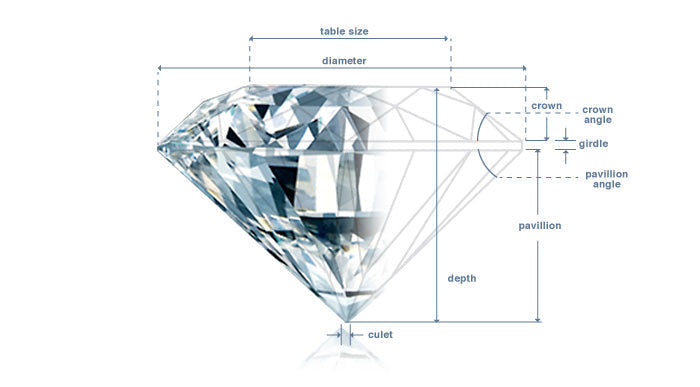
Cut grading combines several technical measurements, table size, total depth, crown and pavilion angles, symmetry and polish, assessed together rather than in isolation. We've broken down the exact percentages and ideal ranges for round, oval and radiant cuts in our Diamond Proportions Guide, worth reading if you want to compare specific certificate numbers directly.
Important nuance: only round brilliant diamonds currently receive a full, official GIA cut grade. Fancy shapes (oval, radiant, pear, marquise and others) are assessed through polish, symmetry and proportions rather than a single overall grade, from GIA at least. IGI already grades cut for nine fancy shapes, and GIA has announced it will extend official cut grading to oval, pear and marquise diamonds starting in 2027. Until then, if you want an overall cut grade on a fancy shape certificate specifically, IGI is currently the more complete option.
The Cut Grade Scale
| Grade | What It Actually Looks Like |
|---|---|
| Excellent | Maximum brilliance and fire, light returns efficiently across the whole stone |
| Very Good | Slightly less light return than Excellent, still genuinely high performance, and considerably more affordable |
| Good | A noticeable step down in sparkle and symmetry compared with the two grades above |
| Fair | Reduced brilliance, dark or dead-looking areas can appear |
| Poor | Flat, glassy appearance, minimal sparkle regardless of colour or clarity |
Our advice, consistent with most independent gemologists: aim for Excellent or Very Good if brilliance is a genuine priority, which for most engagement ring buyers, it is.
Cut vs Shape: Getting the Terms Right
Cut = the quality of craftsmanship and light performance. Shape = the outline of the diamond, round, oval, emerald, and so on.
So "round brilliant" describes a shape. "Excellent Cut Round Brilliant" describes a high-quality version of that shape. The two terms get conflated constantly, and mixing them up is one of the easiest ways to end up comparing the wrong things when shopping.
💎 See excellent-cut craftsmanship in our Aeris Radiant Bezel Ring, customisable with an IGI- or GIA-certified stone.
Why Cut Affects Perceived Size, Not Just Sparkle
A well-cut diamond can genuinely look larger than a poorly cut diamond of identical carat weight. A diamond cut too deep hides weight below the girdle, so the top, the part you actually see, reads smaller. A well-proportioned stone spreads that same weight into more visible surface area and returns more light in the process. Cut, in other words, affects both how brilliant a diamond looks and how big it looks, which is exactly why it's worth prioritising over squeezing out an extra tenth of a carat.
Cut Quality in Fancy Shapes
Since fancy shapes don't currently get a single overall GIA cut grade, here's what to actually check instead:
- Symmetry — balanced curves, evenly aligned facets
- Bowtie effect — the dark area that can appear across the centre of elongated shapes like ovals, pears and marquise; minimal bowtie is the goal
- Depth and table percentages — should sit within the ideal range for that specific shape, covered in full in our proportions guide
We hand-select fancy-shaped lab-grown diamonds for genuine light performance and proportion, not just a headline grade, since the certificate alone doesn't always tell the full story on these shapes.
How Important Is Cut, Really?
Very. You can reasonably compromise on clarity or colour without much visible impact, we've covered exactly how in our clarity and colour guides, but cut is where compromise shows immediately and unmistakably.
Cut matters most when:
- Maximum sparkle is genuinely the priority
- You're working with a smaller carat weight and want it to read larger
- You're setting a solitaire, where the diamond itself, not surrounding stones, carries the entire visual weight
Lab-Grown Diamonds and Cut Quality
Lab-grown diamonds are cut and polished using the same techniques and equipment as mined diamonds, often with more consistency, since controlled growing conditions typically yield rough with fewer natural constraints on how it can be cut. Most of what we offer is Excellent or Very Good cut and fully certified by IGI or GIA.
Invest in Cut First
If brilliance, fire and light return matter to you, and for most people choosing an engagement ring, they genuinely do, cut is the priority. A diamond with perfect colour and clarity will still look flat if it's poorly cut; a diamond with a Good or Very Good cut, comparatively lower colour, and higher clarity will often outperform it visually. Get cut right first, then balance colour, clarity and carat against your budget from there.
How We Approach Cut at VYOR Diamond Lab
Nikolett and I treat cut as the non-negotiable starting point when sourcing every stone, then work with clients to balance the remaining Cs against budget and priorities. Comparing two similarly graded stones side by side under real lighting tells you more in five minutes than any chart can, exactly what a showroom consultation is for.
Frequently Asked Questions
What's the difference between Excellent and Very Good cut? Excellent maximises light return and brilliance; Very Good is a small step down in performance but genuinely high quality, and typically comes at a noticeably lower price, a sensible trade-off for most buyers.
Do all diamond shapes get an official cut grade? No. Only round brilliant diamonds currently receive a full GIA cut grade. IGI grades cut for nine fancy shapes already; GIA plans to extend cut grading to oval, pear and marquise from 2027.
Can a diamond look bigger just from a better cut? Yes. A well-proportioned diamond spreads its weight into more visible surface area and returns more light, so it can genuinely appear larger than a poorly cut diamond of the same carat weight.
Should I prioritise cut over carat? For visible brilliance, generally yes. A smaller, excellently cut diamond will often out-sparkle a larger, poorly cut one, and can even read as similarly sized face-up.
What's the bowtie effect? A dark shadow that can appear across the centre of elongated shapes like ovals, pears and marquise diamonds when proportions aren't well balanced. Minimal bowtie is what to look for.
Explore our Lab-Grown Diamond Engagement Ring Collection, or book a consultation at our Wembley showroom to compare cut grades in person.
Share:
2026 Engagement Ring Trends | What’s In Style This Year?
Coloured Lab-Grown Diamonds: A Complete Guide to Fancy Hues