

2026 Engagement Ring Trends: What's Actually In Style This Year
Last updated July 2026
Engagement ring trends move fast, and a lot of "trend" content online is just recycled opinion. Here's what's actually happening, backed by real 2026 data from The Knot's Real Weddings Study and current retail figures, alongside what we're seeing directly with clients at our Wembley showroom.
1. Lab-Grown Diamonds Have Fully Crossed Into the Mainstream
This isn't really a "trend" anymore, it's the current market reality. The Knot's 2026 Real Weddings Study found lab-grown diamonds now account for 61% of engagement ring centre stones in the US, a 239% increase since 2020, with UK retail data putting adoption even higher, around 70%. Average carat size for lab-grown purchases now sits around 1.9 to 2 carats, noticeably larger than the typical mined stone, at a lower average total spend.
The reason cited most consistently by industry analysts: economic pragmatism. More carat, better colour, higher clarity, for meaningfully less money, without compromising on what the ring actually looks like.
Explore our lab-grown diamond engagement rings — or if you're drawn to even more brilliance at a lower price point, our moissanite engagement rings.
2. Oval Is Closing In on Round, and Elongated Shapes Keep Growing
Round brilliant remains the single most popular shape, but its lead has narrowed considerably, current data puts round at roughly 26% of purchases against oval at around 25%, a gap that's nearly closed entirely. Industry commentators have taken to calling this the "Hailey Bieber effect," referencing the visibility of her oval engagement ring.
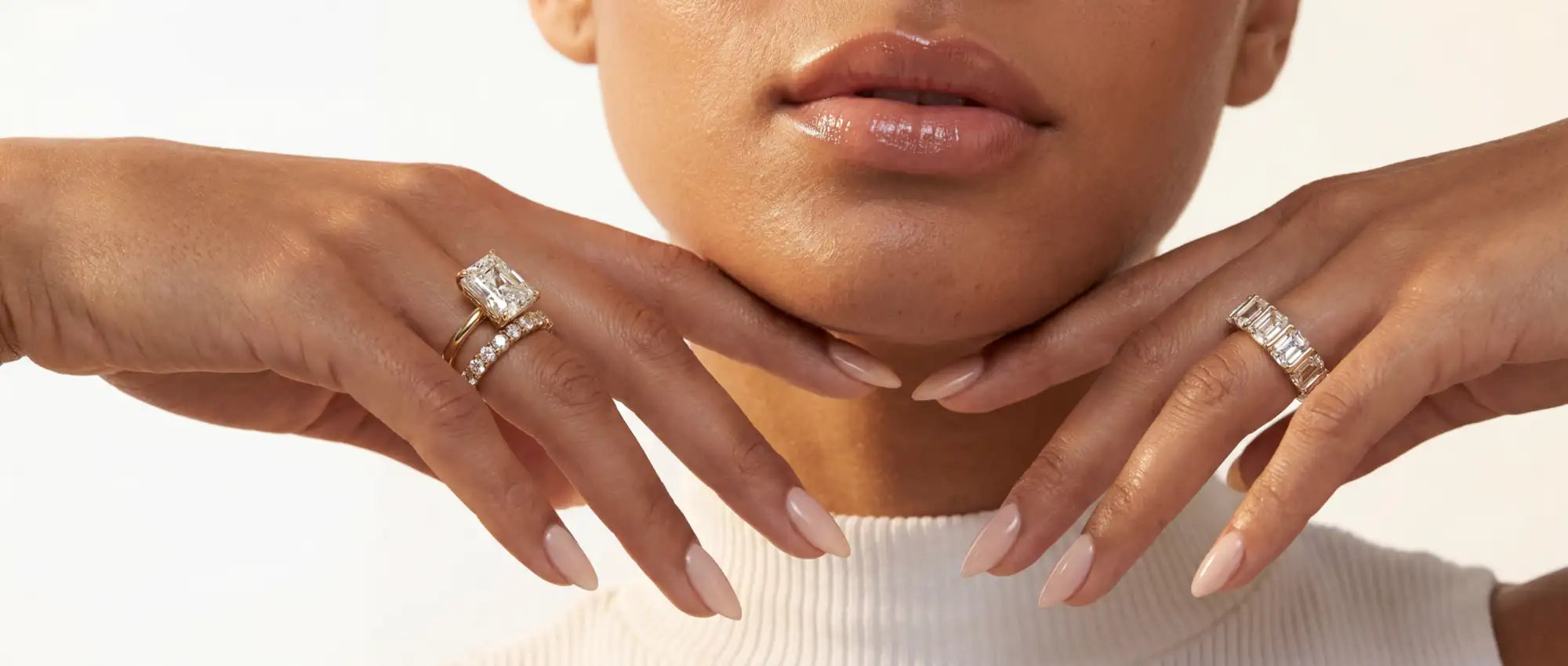
Beyond oval, the shapes showing the fastest growth are emerald cut, marquise, and elongated cushion (a modern take on the antique old-mine cut). All three share the same practical appeal: more visible surface area per carat, which reads as a larger stone for the same weight.
See these shapes in our collection: the Mirella Oval Twisted Pavé, the Lyra East-West Oval Half Bezel, and the Tulip Marquise Cathedral Pavé.
3. Bezel and Half-Bezel Settings Are Genuinely Surging
This is one of the clearest, most data-backed trends for 2026. UK retail figures show rubover (bezel-style) settings up roughly 100% year over year, and bridal designers report the same pull in the US, a deliberate move away from delicate prong settings toward something more secure for daily wear.
What's driving it: bezel settings protect the stone significantly better day to day, and they pair particularly well with round, oval and emerald cuts (full bezel), or marquise and pear shapes (half or three-quarter bezel, which exposes more of the stone while still adding protection).
Two strong examples of this style: the Solara Grande Elongated Cushion Half-Bezel and the Lyra East-West Oval Half Bezel.
4. Yellow Gold Has Genuinely Taken Over Half the Conversation
Yellow gold has more than doubled in popularity over the past five years and now sits at roughly 39% of engagement ring purchases, closing in on white metals, which still lead at around 48% combined (platinum and white gold together). Mixed-metal designs, a yellow gold band with a white gold or platinum head, for example, are increasingly common too, largely because couples want a ring that coordinates with the rest of the jewellery they already wear daily rather than standing apart from it.
Coloured lab-grown centre stones are part of the same broader shift: sales of coloured diamonds are up meaningfully year over year, as couples move away from the assumption that "diamond" automatically means colourless.
5. Halo Settings: A Genuine Correction, Not a Trend Line
Worth being precise here, since a lot of trend content gets this wrong: halo settings actually declined through 2025, down to roughly 5.3% of sales from around 9% the year before. What's more accurate to say for 2026 is that a halo revival is anticipated, driven by a broader swing toward old-money and vintage-inspired styling, rather than halos currently being "everywhere." If you're drawn to a halo, you're ahead of a possible resurgence rather than following a dominant current trend, which is a perfectly good reason to choose one, just worth knowing accurately.
6. Solitaires Still Lead, But Diamond Bands Are the Fastest-Growing Category
The classic solitaire remains the single most popular engagement ring style overall, at around 40% of sales, though that's down from close to 47% the year before as couples personalise the format with curved bands, hidden details and more sculptural silhouettes. The standout growth story is diamond band rings specifically, up from around 22% to 34% of sales year over year, a real shift toward more decorative, statement-led designs rather than a plain metal band beneath the centre stone.
7. Custom Design Is the Default, Not the Exception
Couples are shopping together far more than in previous years, current data shows the person receiving the ring is involved in choosing it close to 80% of the time, with a meaningful share of couples shopping for it jointly from the outset. Lab-grown diamonds and moissanite have made full customisation, stone shape, cut quality, metal, prong style, secret details, genuinely accessible rather than a premium add-on. We build rings from scratch with clients regularly, and this is now the norm we design around, not the exception.
What This Means If You're Shopping in 2026
The data points in a consistent direction: better value on the stone (via lab-grown adoption) is being redirected into more considered design, thicker bands, bezel settings, mixed metals, personalisation, rather than simply spending less overall. That's a genuinely different shopping mindset from a decade ago, and it's exactly the kind of conversation worth having with a jeweller who designs pieces rather than just sells off a shelf.
A note on the data: the specific percentages above are drawn primarily from US and UK studies (The Knot's 2026 Real Weddings Study and UK retail figures), since consolidated Australian-specific data of this depth isn't publicly available. The directional trends, lab-grown adoption, elongated shapes, bezel settings, yellow gold, are consistent with what we're seeing directly with clients at our Wembley showroom.
Book a Consultation and Start Designing
Nikolett and I help clients across Perth and virtually throughout Australia design rings that reflect current craftsmanship trends without chasing them for their own sake, a ring should still feel like yours in five years, not just on-trend today. Book a showroom or virtual consultation and we'll walk you through stones, settings and design options together.
Frequently Asked Questions
What percentage of engagement rings are lab-grown diamonds in 2026? Around 61% in the US and roughly 70% in the UK, according to current retail and survey data, up dramatically from just a few years ago.
What's the most popular engagement ring shape in 2026? Round brilliant remains narrowly the most popular at around 26%, with oval close behind at approximately 25%. Emerald, marquise and elongated cushion are the fastest-growing shapes.
Are halo settings trending in 2026? Not currently, halo sales declined through 2025, though a revival is anticipated as vintage-inspired styling grows in popularity.
Is yellow gold more popular than white gold for engagement rings now? Not yet outright, but it's closing the gap fast, yellow gold sits around 39% of purchases versus roughly 48% for white metals combined, and mixed-metal designs are increasingly common.
Why are bezel settings trending in 2026? Primarily for durability, bezel settings protect the stone significantly better for daily wear than traditional prong settings, and the style itself has shifted toward a more modern, minimalist aesthetic that suits current tastes.
Explore our Engagement Ring Collection, or book a consultation at our Wembley showroom to start designing.
Share:
Diamond Cut Grades Explained: Why Cut Matters Most
Coloured Lab-Grown Diamonds: A Complete Guide to Fancy Hues