

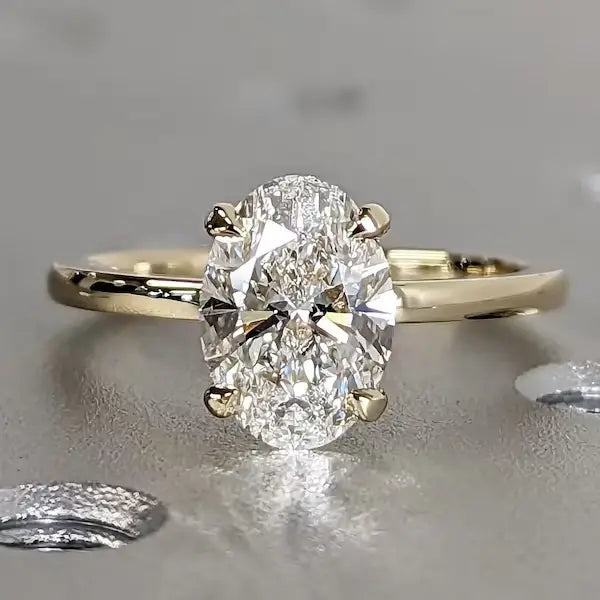
Do Moissanite Engagement Rings Look Cheap? Honestly, No
Last updated July 2026
It's a fair question to ask, moissanite costs a fraction of diamond, and price sometimes gets conflated with perceived quality. But whether a ring looks cheap has almost nothing to do with the stone underneath it, and everything to do with craftsmanship, design and proportion. Here's what actually determines how a ring reads.
What Actually Makes a Ring Look Cheap?
It's rarely the gemstone. A ring reads as cheap when:
- The setting is poorly made or obviously mass-produced
- The metal is low quality, silver-plated or hollow gold rather than solid
- The stone is badly cut, or disproportionately large for the design around it
- The overall styling feels generic or dated rather than intentional
Paired with genuine craftsmanship, moissanite reads as luxurious as diamond, sometimes more striking, given its brilliance.
Moissanite Belongs in High-End Jewellery
Moissanite isn't a "budget simulant." It's a real, lab-created gemstone known for:
- Exceptional brilliance and fire, genuinely exceeding diamond's optical performance in some respects
- Durability, 9.25 on the Mohs scale, well suited to daily wear
- Fully traceable, ethical sourcing
- Premium colour and clarity as standard, D colour and VVS1 clarity in our own stones
Plenty of modern fine jewellers, VYOR Diamond Lab included, design custom, handcrafted rings using moissanite that rival or exceed mined diamond pieces in visual quality.
How to Make a Moissanite Ring Look Genuinely Luxurious
- Choose a high-quality setting. Solid 14K or 18K gold, or platinum, not plated metals or lightweight, hollow construction. This is where perceived value genuinely lives.
- Invest in considered design over generic mass-market settings. A tailored design lifts the whole ring, this is often the single biggest lever available.
- Lean classic where you want timelessness. Solitaire, bezel, or three-stone settings deliver sophistication without needing to compensate with excess detail.
- Get proportions right for your finger and hand. An oversized stone relative to the setting or band can read as flashy rather than elegant; well-proportioned sizing is what actually signals intentional design.
- Choose your cut deliberately. Brilliant and crushed ice cuts genuinely look and feel different, we've gone deep on the trade-offs, including a common misconception about which one hides inclusions better, in our Brilliant vs Crushed Ice guide.
Moissanite Isn't the Same Category as Cheap Simulants
Worth being precise about this distinction, since it's often where the "cheap" association actually comes from:
- Cubic zirconia (CZ) is genuinely softer (around 8 to 8.5 on the Mohs scale) and does lose its shine and clarity over time, this is a real, documented difference, not snobbery.
- Glass or plastic simulants are costume jewellery materials, not intended for fine jewellery use at all.
- Rhinestones are decorative, again not comparable to a genuine gemstone.
Moissanite doesn't cloud or dull with age, and retains its brilliance for a lifetime with reasonable care, we've covered this in full in Will Moissanite Last Forever? Lumping it in with CZ or costume materials is a genuine category error, not a fair comparison.
What People Actually Notice
Almost nobody carries a gem tester to a dinner party. What people actually register when they see a ring:
- How it sparkles
- How it sits and moves on the hand
- Whether it looks considered and well-designed
- Whether it feels like it reflects the wearer
They generally can't tell whether the centre stone is mined diamond, lab-grown diamond, or moissanite, and in practice, they don't need to for the ring to look stunning. If this particular worry, being judged for the material rather than the design, feels familiar, we've addressed it more directly in Will People Know My Ring Isn't a Diamond?
💎 See the principle in action: the Luna Pear Solitaire Ring, a sleek, timeless design built to let a moissanite or lab-grown diamond centre stone genuinely shine.
The Verdict: Design Determines Luxury, Not the Stone's Price
Moissanite doesn't look cheap, poor design does, and that's equally true of diamond rings built on the same mass-produced, low-quality settings. Paired with genuine craftsmanship and thoughtful proportions, a moissanite engagement ring reads as intentional, elevated, and entirely its own thing, not a diamond understudy.
Designing Yours at VYOR Diamond Lab
Nikolett and I build custom moissanite engagement rings with exactly this principle in mind, solid metals, considered proportions, and design choices that let the stone perform at its best. Book a consultation and we'll design something that reads as luxurious as it actually is.
Frequently Asked Questions
Does moissanite look cheap compared to a diamond? Not inherently. What makes a ring look cheap is poor craftsmanship, low-quality metal, or bad proportions, not the specific gemstone used.
Is moissanite the same as cubic zirconia? No. Moissanite is considerably harder (9.25 vs roughly 8 to 8.5 on the Mohs scale) and doesn't cloud or lose brilliance over time the way cubic zirconia does. They're not comparable materials.
How do I make sure my moissanite ring looks high-end? Choose solid gold or platinum rather than plated metal, invest in a considered design over a generic mass-market setting, and get the stone-to-band proportions right for your hand.
Can people tell if my ring is moissanite instead of diamond? Not reliably by eye. Most people notice sparkle, fit and overall design, not the specific mineral underneath, and generally can't distinguish quality moissanite from diamond without specialised equipment.
Does a bigger moissanite stone look more luxurious? Not automatically, proportion matters more than size alone. An oversized stone relative to the setting can read as flashy rather than elegant; well-proportioned sizing signals more considered design.
Explore our Moissanite Engagement Ring Collection, or book a design consultation at our Wembley showroom or online.
Share:
Is Moissanite Too Sparkly? The Honest Answer
Buying a Moissanite Ring: The Complete Buyer's Guide