

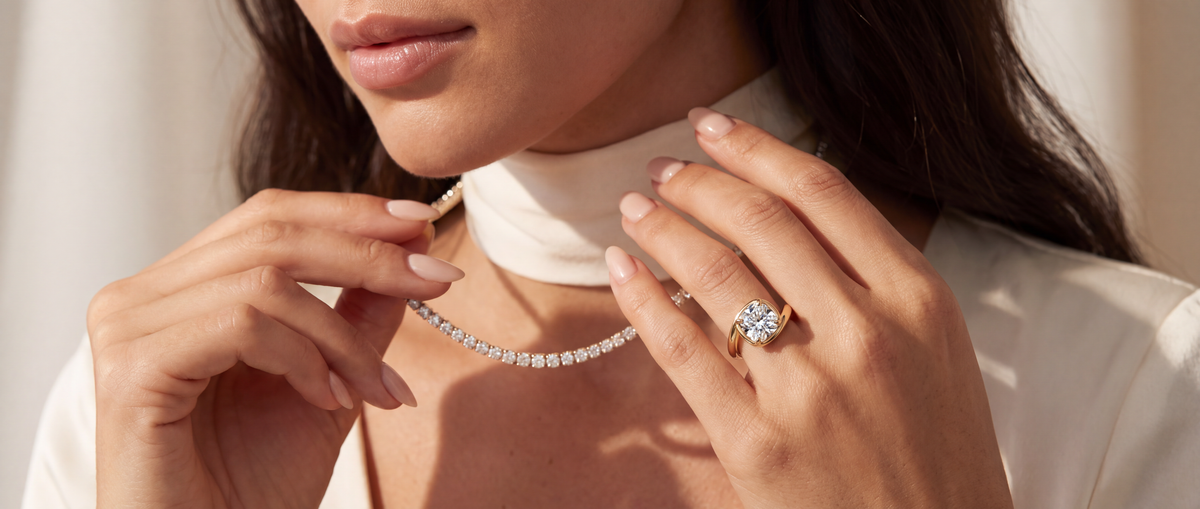
An engagement ring is a personal choice, not a test of how much you spend. Lab-grown diamonds and moissanite can both make beautiful centre stones, but they are not interchangeable. The right choice depends on your partner’s preferences, the appearance you love and what you expect from the ring over time.
This guide separates gemstone facts from matters of taste, with practical questions for Australian buyers.
What is the difference?
A lab-grown diamond is diamond: crystalline carbon with the same essential chemical composition and crystal structure as a mined diamond. Its origin is different. Lab-grown diamonds are produced using processes such as High Pressure High Temperature (HPHT) or Chemical Vapour Deposition (CVD).
Moissanite is silicon carbide, a different gemstone. Jewellery moissanite is typically lab-created. It can be used as a diamond alternative, but it is not diamond. Describing it clearly is important, especially when choosing a ring for someone else.
Recipient expectations: does your partner want a diamond?
Before comparing specifications, consider what the recipient actually wants. For some people, diamond identity carries personal or cultural meaning. Others prefer moissanite’s appearance or would rather put more of their budget towards the setting, wedding or another shared priority.
If your partner has specifically asked for a diamond, a lab-grown diamond meets that gemstone preference; moissanite does not. If they are open to either, compare them together rather than assuming a larger stone will be more welcome.
You can preserve the surprise while discussing broad preferences: “Would you prefer a diamond, or are you interested in other gemstones?” Neither answer is more sophisticated or more romantic. Acceptance is personal, not something a jeweller can guarantee.
Appearance: classic diamond sparkle or more rainbow fire?
Both stones can look bright and beautiful, but their optical properties differ. Moissanite has greater dispersion than diamond, meaning it can display more rainbow-coloured flashes, often called fire. Diamond offers a different balance of white light, coloured flashes and contrast.
More fire is a measurable characteristic, not proof that one stone looks better. Some buyers love moissanite’s lively flashes; others prefer diamond’s optical character. Cut, shape, size and lighting all affect the result.
Moissanite is also doubly refractive, which can produce visible facet doubling in some viewing directions. Whether you notice this depends on the stone and how you view it. Avoid relying on claims that nobody can tell the difference.
Compare stones in daylight and ordinary indoor lighting, not only under showroom spotlights. Look for a tint you enjoy, crisp facets and a balanced appearance. Diamond-style colour labels used to market moissanite should not be treated as directly equivalent to an independent diamond grade.
Durability: suitable for daily wear, not indestructible
Diamond is rated 10 on the Mohs hardness scale; moissanite is commonly rated around 9.25. Both offer strong scratch resistance for jewellery. The scale is not linear, and hardness measures resistance to scratching, not resistance to every kind of damage.
Either stone can be damaged by a hard impact. A secure setting, protective prongs and regular checks matter, especially for pointed shapes. Neither stone makes the ring’s metal or setting immune to wear.
Remove your ring for weight training, heavy manual work and activities that risk impact or snagging. Avoid exposing it to harsh chemicals. Choose the setting with your lifestyle in mind rather than treating stone hardness as permission to wear it everywhere.
Certification: what does the paperwork actually establish?
For a lab-grown diamond, ask whether the individual stone has an independent grading report and review what that report records. Depending on the laboratory and report format, it may document identity, laboratory-grown origin, measurements, colour, clarity and cut information. Not every lab-grown diamond is sold with an individual report.
Moissanite may come with an authenticity certificate or manufacturer warranty. These are not automatically equivalent to an independent diamond grading report. Diamond-style grades and carat-equivalent descriptions may be marketing conventions rather than like-for-like standards.
For either stone, ask who issued the documentation, whether it identifies your particular stone and what any warranty excludes. A grading report describes a gemstone; it is not a resale guarantee or an insurance valuation.
Resale and long-term value: buy for enjoyment, not a promised return
Neither a lab-grown diamond nor moissanite should be bought on the assumption that it will retain its purchase price. Retail pricing, second-hand demand, selling fees and the value of the setting can all influence what a buyer might offer later.
Lab-grown diamond prices have changed as production and supply have developed. Moissanite also has uncertain second-hand demand. There is no dependable percentage of your purchase price that we can promise you will recover for either stone.
Replacement value, retail price and resale value are different things. A high insurance valuation does not mean someone will pay that amount for your ring. Mined diamonds are not automatically reliable investments either.
If resale matters, ask about any written buyback or upgrade policy before purchase. Check eligibility, fees and conditions rather than relying on a verbal impression. For many couples, long-term value means enjoying the ring, maintaining it and choosing a design they still love years later.
Insurance in Australia: confirm the stone and the policy
Ask an insurer whether it will cover the particular ring before assuming it is protected. Coverage depends on the policy and underwriting, not simply on whether the centre stone is diamond or moissanite.
Describe the gemstone accurately as a lab-grown diamond or moissanite. Keep your receipt, stone documentation and photographs, and ask whether the insurer requires a current valuation from a suitably qualified valuer.
Compare cover for accidental damage, theft and accidental loss. Check exclusions, excesses, travel limits and whether cover applies away from home. Ask whether a claim results in repair, replacement or a cash settlement, and how a like-for-like replacement is defined.
For a lab-grown diamond, confirm that the replacement basis recognises its laboratory-grown origin. For moissanite, confirm that the policy records moissanite rather than assuming diamond. Do not presume a home contents policy covers every situation in which you wear your ring.
Ethical tradeoffs: look beyond the label
Lab-created centre stones avoid the extraction of that particular gemstone from a mine. That is a relevant distinction, but it does not make every lab-grown diamond or moissanite automatically carbon-neutral, impact-free or ethically superior in every respect.
Manufacturing uses energy and materials. Environmental impacts depend on the production method, electricity source, supply chain and transport. Without comparable, independently supported evidence, it is not responsible to claim that moissanite always has a lower footprint than a lab-grown diamond, or that either is universally more ethical than every mined stone.
The ring also includes metal, labour and sometimes other gemstones. Ask about sourcing, recycled-metal claims, manufacturing conditions and the evidence behind any sustainability certification. Prefer specific, verifiable information over broad labels such as “eco-friendly”.
Budget and size: compare the complete ring
Moissanite often costs less than a lab-grown diamond of a similar face-up size, but compare actual quotes rather than assuming a fixed price gap. Setting metal, workmanship, side stones, documentation and aftercare all contribute to the final price.
Compare measurements in millimetres as well as weight. A moissanite described by diamond-equivalent weight is not necessarily being sold at that actual carat weight. Shape and cut also affect how large either stone appears.
Which is right for you?
A lab-grown diamond may be the better fit if diamond identity matters to your partner, you prefer diamond’s optical character and you want the option of independent diamond grading documentation.
Moissanite may be the better fit if your partner welcomes a different gemstone, loves its rainbow fire and wants to prioritise size or setting within the available budget.
If you are undecided, start with the recipient’s preference, then compare appearance in everyday lighting. Review the paperwork, care requirements and insurance terms before deciding. Choose the ring for its meaning and wearability, not a resale promise or an unsupported ethical claim.
Explore VYOR’s Lab Grown Diamond Engagement Rings and Moissanite Engagement Rings to compare designs for your story.
Share:
Buying a Lab-Grown Diamond Engagement Ring in Perth