

Lab-Grown vs Mined Diamonds: The Real Differences in 2026
Last updated July 2026
Nearly every diamond shopper hits this question early: lab-grown or mined? Both are genuine diamonds, chemically and optically identical, but the differences that actually matter, price, ethics, environmental impact, and long-term value, are often explained with outdated numbers or oversimplified claims. Here's where things actually stand.
What Is a Lab-Grown Diamond?
A lab-grown diamond is a real diamond grown in a controlled laboratory environment rather than beneath the earth's crust. It's chemically, physically and optically identical to a mined diamond, same carbon crystal structure, same hardness (10 on the Mohs scale), same fire and brilliance.
Two methods are used to grow them:
- HPHT (High Pressure High Temperature) — replicates the pressure and heat conditions found deep within the earth
- CVD (Chemical Vapour Deposition) — grows the diamond layer by layer from carbon-rich gas
Neither method is inherently better; the quality of the finished stone depends on the individual diamond, not the growth method alone. For a deeper look at how each process works, see our guide on how lab-grown diamonds are made.
Lab-grown diamonds are not simulants. They're not cubic zirconia and not moissanite, which is a different mineral entirely. A lab-grown diamond is still classified, graded and certified as a diamond, using the same 4Cs framework as a mined stone.
What Is a Mined Diamond?
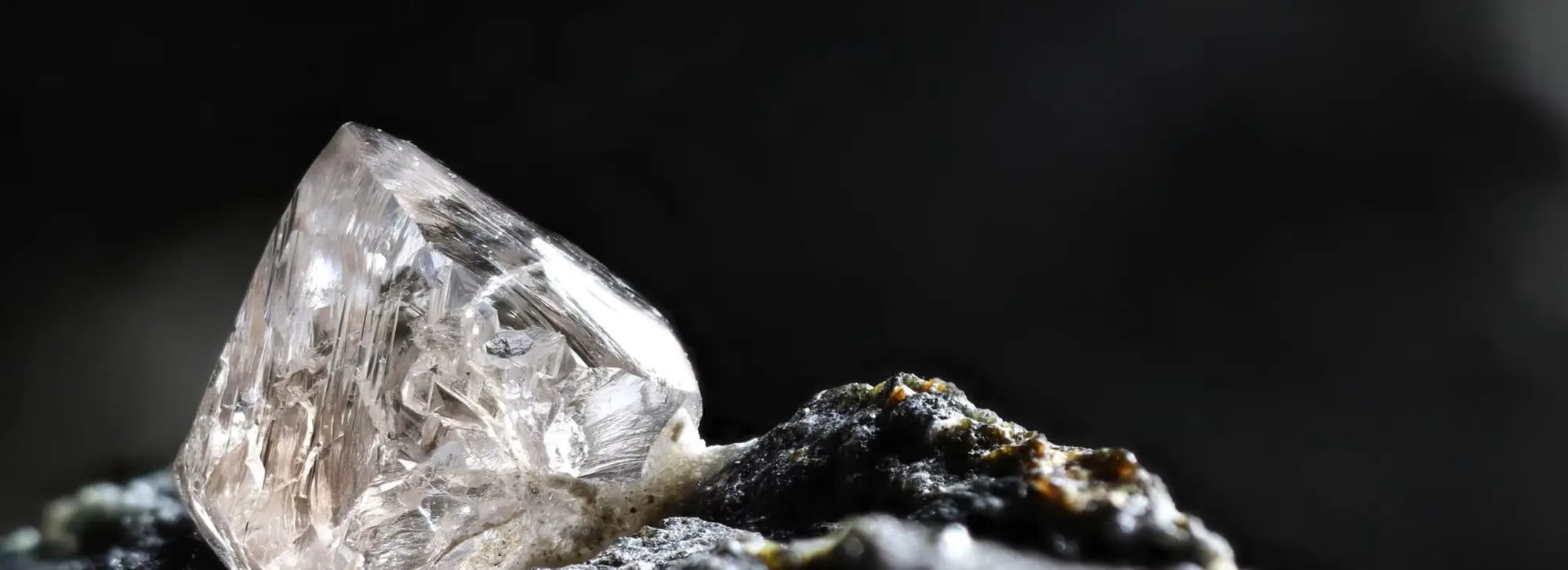
A mined diamond forms naturally over roughly one to three billion years, under extreme heat and pressure deep within the earth's mantle, then reaches the surface through volcanic activity and is extracted through open-pit, underground or alluvial mining.
Their appeal is largely about origin: a mined diamond carries a geological history that can't be replicated. That history is also where most of the ethical and environmental scrutiny of the diamond industry comes from.
The Real Differences
1. Price
This is where the two diverge most sharply, and it's widened considerably in the last few years. As of 2026, lab-grown diamonds typically cost around 70 to 90% less than a mined diamond of comparable cut, colour, clarity and carat weight. For context, a 1-carat mined diamond that might sell for USD $4,000–$10,000 has a lab-grown equivalent in the vicinity of USD $1,000–$3,000 for the same specification.
Worth noting: by late 2025, prices for premium 1-carat lab-grown diamonds (D–E colour, VVS clarity) reached a market floor. The years of continuous price drops for top-spec stones have largely levelled off, though prices for lower specifications and larger sizes are still adjusting.
2. Ethics and Sourcing
Lab-grown diamonds are grown in controlled facilities with a fully traceable origin, so there's no ambiguity about where the stone came from.
Mined diamonds have improved significantly on this front through the Kimberley Process, which restricts the trade of diamonds funding armed conflict. It's worth understanding its limits, though: the Kimberley Process addresses conflict financing specifically, not broader labour or working-condition standards, so it isn't a complete guarantee of ethical sourcing on its own. Reputable mined-diamond suppliers back it up with their own supply chain due diligence.
3. Environmental Impact
This one deserves more nuance than most retailers give it. Diamond mining does carry a well-documented environmental footprint, land disruption, water use, and carbon emissions from extraction and processing.
Lab-grown diamonds avoid the land disruption of mining, but they're not automatically the lower-impact option, it depends entirely on the energy source used to grow them. A diamond grown using renewable energy has a meaningfully smaller footprint; one grown on a coal-heavy grid may not. The US Federal Trade Commission has specifically cautioned jewellery brands against making blanket "eco-friendly" or "sustainable" claims about lab-grown diamonds without being able to substantiate them, so we'd rather be accurate here than make a claim we can't back up. If sustainability is a priority for you, ask any retailer, us included, what energy source was used to grow the specific stone you're considering.
4. Appearance and Quality
Side by side, a well-cut lab-grown diamond and a well-cut mined diamond are indistinguishable to the naked eye, and usually to a jeweller's loupe too. Telling them apart requires specialised equipment like spectroscopy. Both are graded on the same 4Cs (cut, colour, clarity, carat) by the same gemological labs. For a closer look at how clarity specifically is assessed, see our guide to diamond clarity.
5. Certification
Both lab-grown and mined diamonds are certified by IGI or GIA. It's worth knowing that GIA changed how it grades lab-grown diamonds in October 2025, moving to a simplified Premium/Standard system rather than the detailed 4Cs scale it still uses for mined stones. We've covered this in full in our guide to lab-grown diamond certification.
6. Resale and Long-Term Value
Neither type of diamond should be treated as a financial investment; that's true across the industry, not just for lab-grown stones. That said, there's a real difference in degree. Mined diamonds typically retain somewhere in the range of 25 to 50% of their retail price on resale, supported by their finite supply. Lab-grown diamonds retain considerably less, often in the 10 to 30% range, because new stones can be produced on demand, so there's no scarcity underpinning resale prices.
For most buyers this isn't the deciding factor; it's a piece of jewellery to be worn and cherished, not a liquid asset. We go into this in more detail in why resale value shouldn't drive your decision.
Which Should You Choose?
There's no universally correct answer, only what matches your priorities:
- Choose lab-grown if: you want to maximise size and quality for your budget, prioritise traceable sourcing, or simply prefer the value proposition
- Choose mined if: the geological history and finite rarity of a natural stone matters to you, or resale value is a genuine priority
Both are, unambiguously, real diamonds.
How We Help You Decide at VYOR Diamond Lab
Nikolett and I work with both lab-grown diamonds and moissanite at our Wembley showroom, and we're upfront about the trade-offs of each rather than steering you toward whichever has the better margin. If you're weighing lab-grown against mined, or wondering whether moissanite might suit your budget better still, we'll walk you through actual stones side by side so you can decide with your own eyes, not just a spec sheet.
Frequently Asked Questions
Are lab-grown diamonds real diamonds? Yes. They're chemically, physically and optically identical to mined diamonds. The only difference is where and how they formed.
How much cheaper are lab-grown diamonds than mined diamonds in 2026? Typically 70 to 90% less for a comparable cut, colour, clarity and carat weight, though the exact gap depends on the specific stone.
Do lab-grown diamonds hold their value? Not well, and neither do mined diamonds in a strict investment sense. Mined diamonds typically retain 25 to 50% of retail price on resale; lab-grown diamonds typically retain 10 to 30%.
Are lab-grown diamonds better for the environment than mined diamonds? It depends on the energy source used to grow them. Renewable-energy production has a meaningfully lower footprint than mining; coal-powered production may not. There's no blanket answer that applies to every stone.
Can you tell a lab-grown diamond from a mined diamond by looking at it? No, not with the naked eye, and rarely even under a standard loupe. Distinguishing them requires specialised equipment such as spectroscopy.
Explore our Lab-Grown Diamond Engagement Ring Collection, or book a consultation at our Wembley showroom to compare lab-grown and mined options in person.


Share:
What is an IGI Certificate? Understanding Lab Grown Diamond Certification
Why Choose a Lab-Grown Diamond? A Gemologist's Honest Take