

Are Lab-Grown Diamonds Real Diamonds? What "Real" Actually Means
Last updated July 2026
This question gets asked constantly, and the short answer is genuinely simple: yes, a lab-grown diamond is a real diamond. But the word "real" carries more baggage in the diamond trade than in ordinary conversation, and understanding why is actually the more useful part of the answer.
The Scientific Answer: Yes, Unambiguously
A lab-grown diamond and a mined diamond are the same material: pure crystallised carbon, arranged in the same isometric crystal structure. They share:
- Identical hardness — 10 on the Mohs scale
- Identical refractive index — 2.42, which is what produces a diamond's characteristic fire and brilliance
- Identical thermal conductivity
- Identical specific gravity — 3.52
The only difference is origin: one formed underground over roughly one to three billion years, the other grew in a controlled facility over several weeks. Neither the Gemological Institute of America (GIA) nor the International Gemological Institute (IGI) treats lab-grown stones as a separate category of material, they're graded as diamonds, using the same fundamental 4Cs framework.
Where the Confusion Comes From
The confusion isn't scientific, it's regulatory and marketing history. In 2018, the US Federal Trade Commission (FTC) revised its Jewelry Guides and removed the word "natural" from its formal definition of a diamond, effectively acknowledging that a diamond is defined by what it's made of, not where it came from.
That's often reported as "the FTC declared lab-grown diamonds are real diamonds," which is broadly true but leaves out an important detail. The FTC still requires sellers to clearly and conspicuously disclose when a diamond is lab-grown, placing a qualifying word like "laboratory-grown" or "laboratory-created" immediately next to the word "diamond," with equal visibility. Industry guidance following the ruling has also confirmed that when the word "diamond" is used entirely on its own, without any qualifier, it's still generally understood to mean a mined diamond.
So the accurate summary is this: a lab-grown diamond is a genuine, scientifically real diamond, and it's entitled to be called one. But responsible sellers (VYOR Diamond Lab included) will always tell you plainly whether a specific stone is lab-grown or mined, because leaving that ambiguous is exactly the kind of thing regulators, and buyers, rightly take issue with.
Do They Perform the Same?
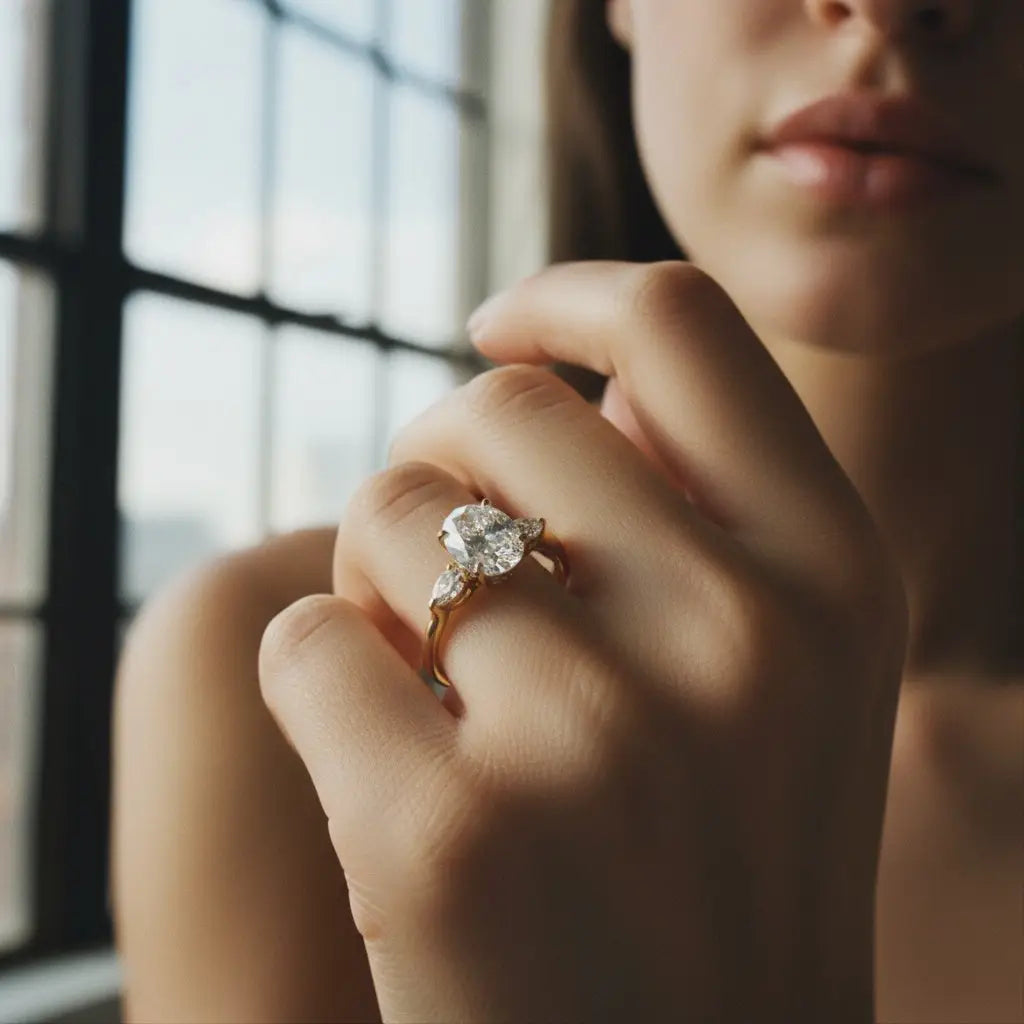
Yes. Brilliance, fire and scintillation come from cut quality and the 4Cs, not from origin. A well-cut lab-grown diamond will outperform a poorly cut mined diamond every time, and vice versa. If you'd like to see this in a specific setting, the Solara Oval Half Bezel Ring is a good example of how cut quality shows up regardless of stone origin.
Are They Certified the Same Way?
Largely, yes, both are graded by IGI or GIA using the 4Cs. One current nuance: since October 2025, GIA grades lab-grown diamonds on a simplified Premium/Standard system rather than the detailed letter-and-number grading it still uses for mined stones, while IGI continues full 4Cs grading for lab-grown diamonds. This doesn't affect whether a stone is "real"; it's simply a different reporting format. We've covered exactly what this means for a certificate in our lab-grown certification guide.
What About Price and Ethics, Then?
If lab-grown and mined diamonds are equally "real," why the significant price gap, and why does the ethics conversation favour lab-grown? Because "real" was never actually the relevant question for either of those, scarcity and production method are.
- Price reflects supply and production economics, not authenticity. Mined diamonds are finite and expensive to extract; lab-grown diamonds can be produced on demand with a shorter, more controlled supply chain. As of 2026, that gap runs around 70 to 90% for a comparable stone. Full pricing detail is in our lab-grown vs mined comparison.
- Ethics is about supply chain, not material. Lab-grown diamonds have a fully traceable origin. Mined diamonds have improved substantially through initiatives like the Kimberley Process, though that framework addresses conflict financing specifically rather than every labour and environmental consideration.
- Environmental impact genuinely depends on the individual producer, particularly the energy source used to grow a lab-grown stone. This is one area where we'd rather be precise than repeat a blanket claim: the FTC has specifically cautioned against unqualified "eco-friendly" claims for lab-grown diamonds, because impact varies by producer rather than being uniformly lower.
None of this changes whether a lab-grown diamond is real. It's a separate, and separately important, set of questions.
How We Handle This at VYOR Diamond Lab
Every stone we sell, lab-grown, mined referral, or moissanite, is disclosed plainly, with the certificate to match. Nikolett and I would rather you understand exactly what you're buying than have to untangle vague marketing language after the fact. That's the whole point of an appointment-only consultation at our Wembley showroom: you see the actual stone, the actual certificate, and get a straight answer to every question, including this one.
Frequently Asked Questions
Are lab-grown diamonds legally considered real diamonds? Yes, in the sense that regulatory bodies like the FTC define a diamond by its material composition, not its origin. Sellers are still required to clearly disclose when a diamond is lab-grown rather than mined.
Does GIA consider lab-grown diamonds real diamonds? Yes. GIA grades lab-grown diamonds using the same fundamental diamond framework, though its lab-grown reporting format changed to a Premium/Standard system in October 2025.
If lab-grown and mined diamonds are equally real, why is one so much cheaper? Because price reflects scarcity and production method, not authenticity. Mined diamonds are finite and costly to extract; lab-grown diamonds can be produced on demand, which is why the price gap runs around 70 to 90% in 2026.
Do sellers have to disclose if a diamond is lab-grown? Yes. Regulatory guidance requires clear and conspicuous disclosure alongside the word "diamond" whenever a stone is lab-grown rather than mined.
Is a lab-grown diamond the same as moissanite or cubic zirconia? No. Both are entirely different materials, not diamonds at all. A lab-grown diamond is genuine diamond, grown above ground rather than mined.
Explore our Lab-Grown Diamond Engagement Ring Collection, or book a consultation at our Wembley showroom to see certified stones in person.

Share:
Diamond Proportions Guide: Why Cut and Symmetry Matter
Are Lab-Grown Diamonds Lower Quality? The Facts, Explained