

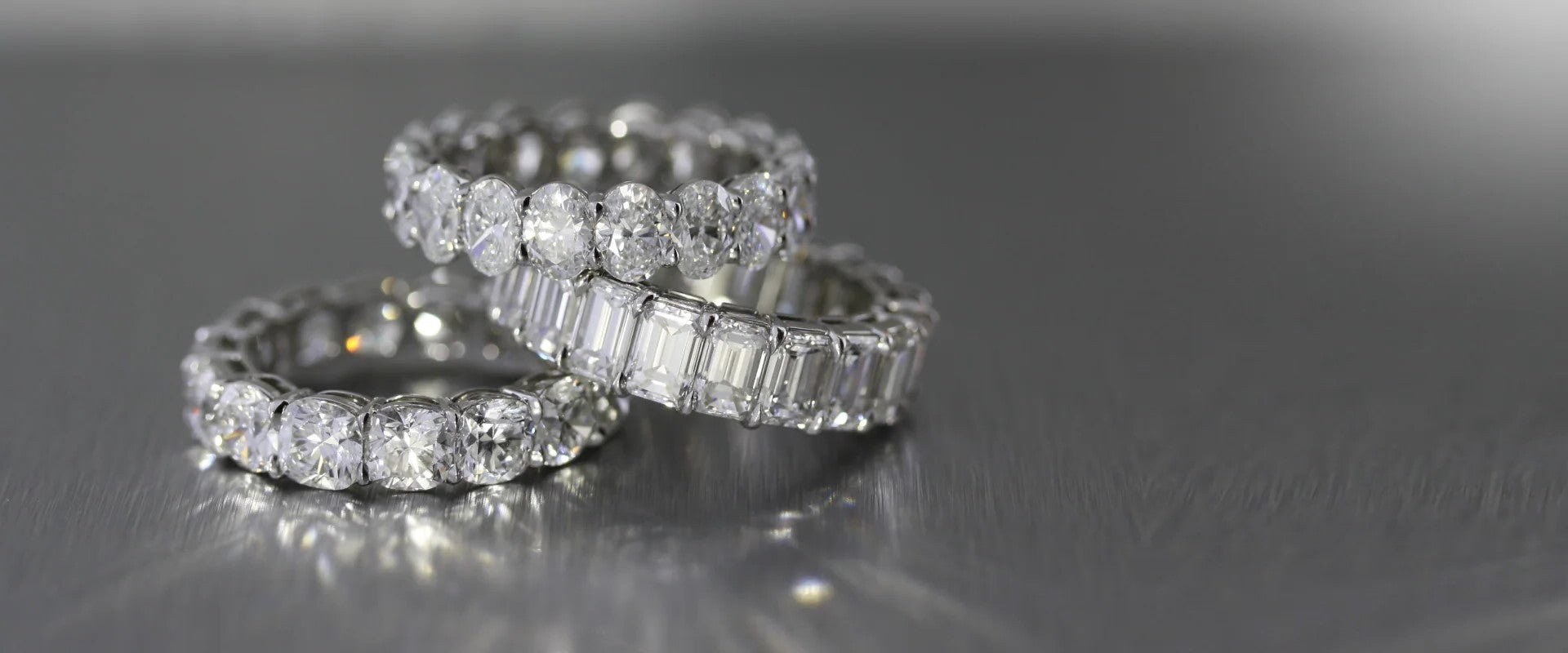
The Best Wedding Band and Engagement Ring Combinations
Last updated July 2026
If you already know your engagement ring's setting style and just want to know what pairs well, this is the quick-reference version. For the deeper principles behind contour, metal matching, and proportion, our full guide to matching your engagement ring and wedding band covers that in depth. Here, it's setting by setting.
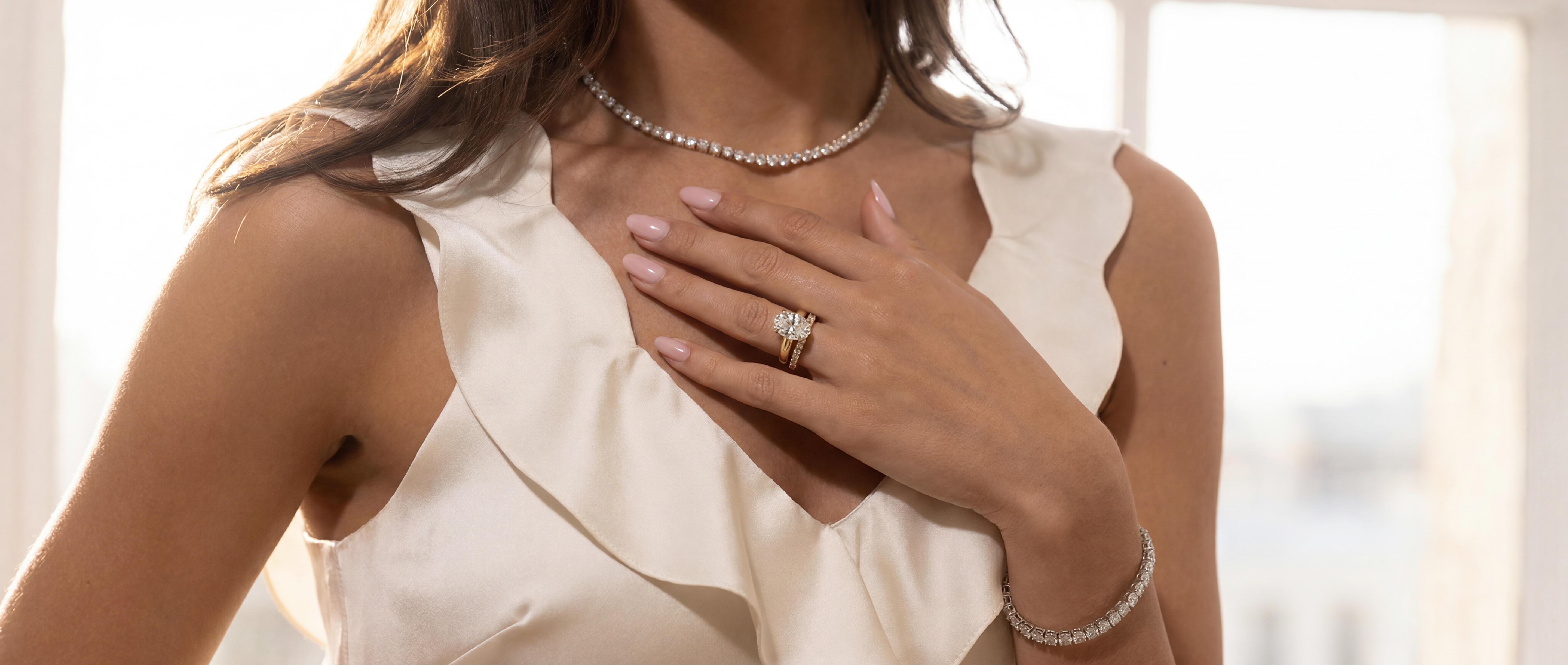
Solitaire Engagement Rings
Best pairings:
- A classic gold or platinum band, for timeless, understated elegance
- A pavé band, adding sparkle without competing with the centre stone
- A contoured or notched band, essential if the setting sits low enough to leave a gap against a straight band
A solitaire's simplicity is exactly what makes it so versatile, round, oval, or cushion cut, it pairs comfortably with almost any band style you're drawn to.
Hidden Halo Rings
Best pairings:
- A slim pavé or plain band, letting the hidden halo's sparkle read from underneath rather than competing with it
- A chevron or curved band, contouring neatly around the raised basket
Hidden halo rings tend to sit a little higher than a standard solitaire, which genuinely gives more flexibility in band shape than you might expect.
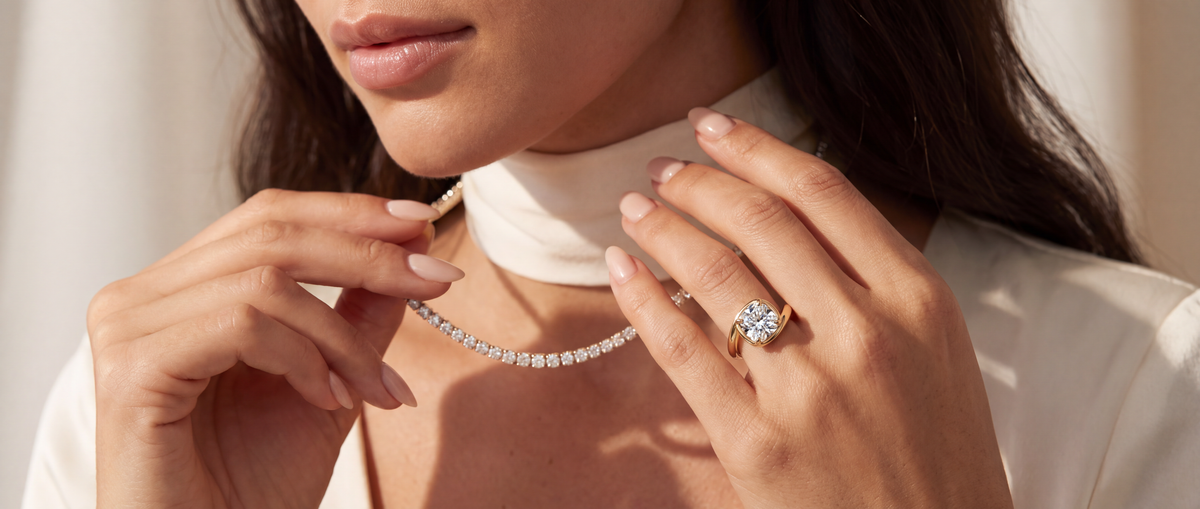
Bezel or Half-Bezel Rings
Best pairings:
- A straight, flat band for a clean, minimalist look
- A split or curved band that hugs the bezel's contour for a more contemporary feel
Bezel settings are practical and sleek by nature, a plain platinum band reinforces those clean lines, while a wrap-style band adds a bit more visual interest without losing the setting's inherent simplicity.
Three-Stone Engagement Rings
Best pairings:
- A matching pavé or channel-set band to preserve symmetry across the whole hand
- A tapered band that narrows slightly as it approaches the side stones
Three-stone rings carry real symbolic weight, past, present, future, and a sleek, cohesive band keeps that meaning intact without crowding the design.
Cathedral or East-West Settings
Best pairings:
- A flush or shadow band for cathedral settings, tucking beneath the raised shoulders rather than competing with them
- A minimalist curved band for east-west rings, respecting the horizontal orientation rather than clashing against it
One extra consideration for east-west settings specifically: if your centre stone is an elongated shape (oval, marquise, or pear), it's worth checking the stone's bow tie effect before finalising the pairing, since the east-west orientation can make an existing bow tie more visible, which affects how the whole set reads together, not just the engagement ring alone.
Does the Stone Shape Itself Change the Best Pairing?
Genuinely, yes:
- Round or oval — extremely versatile, works comfortably with most band styles
- Emerald or Asscher — pairs beautifully with geometric, flat-profile bands that echo the step-cut's clean lines
- Marquise or pear — benefits from a contoured or subtly pointed band that echoes the stone's own silhouette
- Princess or radiant — pairs well with a square-set diamond band for clean visual alignment
Explore Emerald Cut Engagement Rings or Marquise Cut Engagement Rings to see these pairings applied directly.
Avoiding Gaps Between the Two Rings
The single most common frustration we hear: an engagement ring and band that simply won't sit flush together. The usual fixes:
- Choosing a raised or cathedral setting from the outset, which naturally leaves room for a straight band beneath it
- Designing a curved or notched wedding band specifically shaped to the engagement ring
- Planning both rings as a custom-fit set from the beginning, rather than sourcing the band separately later
Should Your Partner's Ring Match Yours?
Not necessarily. Some couples want matching metals or shared design details; others prefer entirely distinct styles that still feel connected in spirit. There's no fixed rule, subtle cohesion, the same metal tone, or a shared engraving, without identical design, is a common, effective middle ground.
Frequently Asked Questions
Can I wear my engagement ring and wedding band separately day to day?
Yes, plenty of people wear only the band daily and save the engagement ring for special occasions. If that's likely to be you, choose a band that looks genuinely complete on its own.
What exactly is a "bridal set"?
A bridal set simply means the engagement ring and wedding band were designed together, intentionally, to be worn as one cohesive look rather than sourced separately.
Should I buy both rings at the same time?
It helps, particularly for tricky settings or unusual shapes, since the band can be planned around the engagement ring's exact proportions. That said, a wedding band can also be custom-designed later to match an existing ring.
Can I mix a lab-grown diamond engagement ring with a moissanite-accented band?
Absolutely. Plenty of clients do exactly this, it comes down to your own aesthetic and priorities, not a rule about matching materials.
Ready to design your dream pair? Book a consultation at our Wembley showroom or online, or explore our Women's Wedding Rings to start planning your set.
Share:
What to Engrave on Your Wedding Ring
Bride and Groom Wedding Ring Sets: Creating a Meaningful Match