

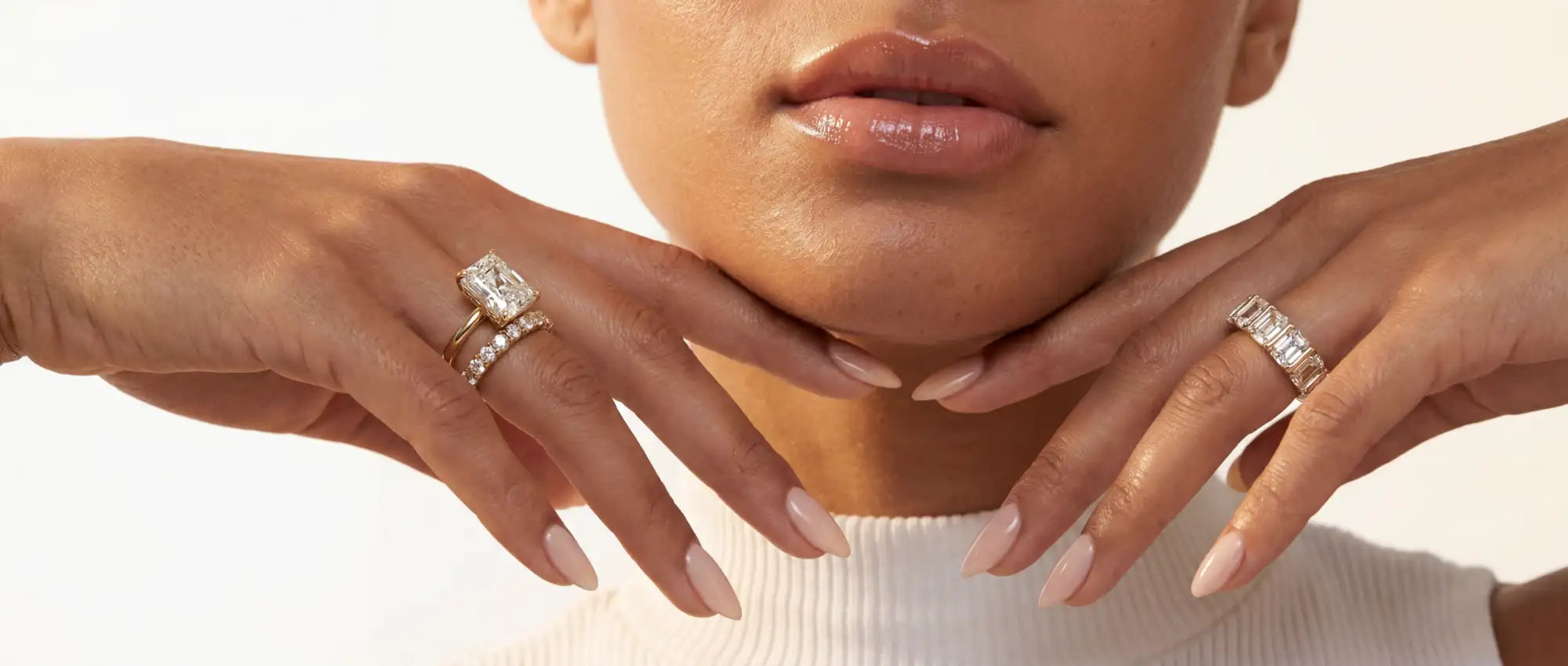
How to Match Your Engagement Ring and Wedding Band
Last updated July 2026
Your wedding band isn't just a ring, it's the one you'll wear every day, side by side with your engagement ring, for decades. Getting the pairing right isn't only about matching, it's about real harmony between two pieces that need to work together permanently.
1. Start With the Engagement Ring
Your engagement ring sets the terms. Its shape, height, and design details determine what kind of band will genuinely sit flush, enhance the centre stone, or frame the whole look properly.
Worth considering:
- Setting height — does the engagement ring sit high or low against the finger?
- Stone shape — round, oval, emerald, pear, and so on
- Design detail — a hidden halo, a pavé band, cathedral shoulders, all change what pairs well
A clean solitaire is genuinely versatile with almost any band style. A hidden halo pairs beautifully with contoured or pavé bands. A cathedral setting generally benefits from a band that sits slightly lower or tapers to meet it.
2. Consider the Contour
If your engagement ring has a low setting or a wider basket, a straight wedding band may not actually sit flush against it. This is where curved, V-shaped, or notched bands come in, designed specifically to hug the centre stone's profile rather than fight it.
Custom contour bands can be shaped precisely to your engagement ring. Common approaches:
- A subtle curve that mirrors the halo or stone outline
- A chevron or knife-edge V band for contrast and visual layering
- A shaped eternity band that wraps neatly around a round or oval cut
3. Match or Deliberately Mix Metals
The classic approach is matching, an 18K yellow gold engagement ring pairs with an 18K yellow gold band. The more contemporary approach is deliberate contrast, a white gold engagement ring with a rose gold band, for instance, adds genuine dimension rather than looking mismatched.
A few practical notes either way:
- Keep karat quality consistent (18K with 18K, not mixed with 14K) for a cohesive finish
- Match the surface finish, matte against matte, polished against polished, unless contrast is the specific goal
- A two-tone band can bridge two metal colours in a single piece if you want both without fully committing to either
4. Get the Proportions Right
Balance matters more than matching here. A bold three-stone or halo engagement ring pairs well with a delicate micro pavé band, adding refinement without competing for attention. A more minimal engagement ring, on the other hand, can carry a more elaborate diamond-set eternity band without looking overdone.
A few pairing directions that tend to work well:
- A round solitaire with a classic pavé band
- An east-west emerald cut with a half-bezel band
- A cushion cut with a soft, curved custom-shaped band
5. Think Ahead to Future Stacking
If an anniversary band might join the stack down the line, it's worth leaving some visual space for a third ring now rather than designing the pairing as a closed, two-ring set. Alternating textures and widths across a growing stack tends to read as intentional rather than cluttered.
6. Don't Be Afraid to Custom Design
Sometimes the right band simply doesn't exist off the shelf yet. Custom-made bands can match your engagement ring's exact curve, height, and finish, with engraving, hidden stones, or bespoke gemstone additions layered in as well.
7. Popular Pairings We See Regularly
| Engagement Ring Style | Wedding Band That Tends to Work |
|---|---|
| Round solitaire | Micro pavé, twisted band, or plain polished gold |
| Oval hidden halo | Curved pavé or knife-edge band |
| East-west emerald cut | Straight pavé or half-bezel |
| Three-stone ring | Thin eternity or notched band |
| Cushion cathedral | Custom contour with a subtle curve |
Final Thoughts
Your wedding band should feel like a natural extension of the engagement ring, but genuinely hold its own too. Whether you land on a closely matched pair or a more eclectic combination, the right pairing is simply the one that feels most like you, worn daily, for the rest of your life together.
Frequently Asked Questions
Do my engagement ring and wedding band have to match exactly?
No, complementary works just as well as identical. Contrast in metal or texture can look genuinely intentional rather than mismatched, if it's planned rather than accidental.
What if my engagement ring won't sit flush with a straight band?
This is common with low settings or wider baskets. A custom contour, curved, notched, or V-shaped, band is designed specifically to solve this.
Can I mix metal tones between my two rings?
Yes, genuinely well, if the karat quality and finish are considered together rather than left to chance.
Should I plan for a future anniversary band now?
Worth thinking about early. Leaving some visual space in the current pairing makes it easier to add a third ring later without the stack feeling crowded.
Can a wedding band be fully custom-shaped to my engagement ring?
Yes, this is one of the most common custom requests we get, matching curve, height, and finish precisely to an existing engagement ring.
Ready to find your perfect pairing? Book a consultation at our Wembley showroom or online, or explore our Women's Wedding Rings to see pairing options in person.
Share:
The VYOR Diamond Lab Guide to Styling Stacker Rings
How Much Should You Spend on Wedding Rings?