

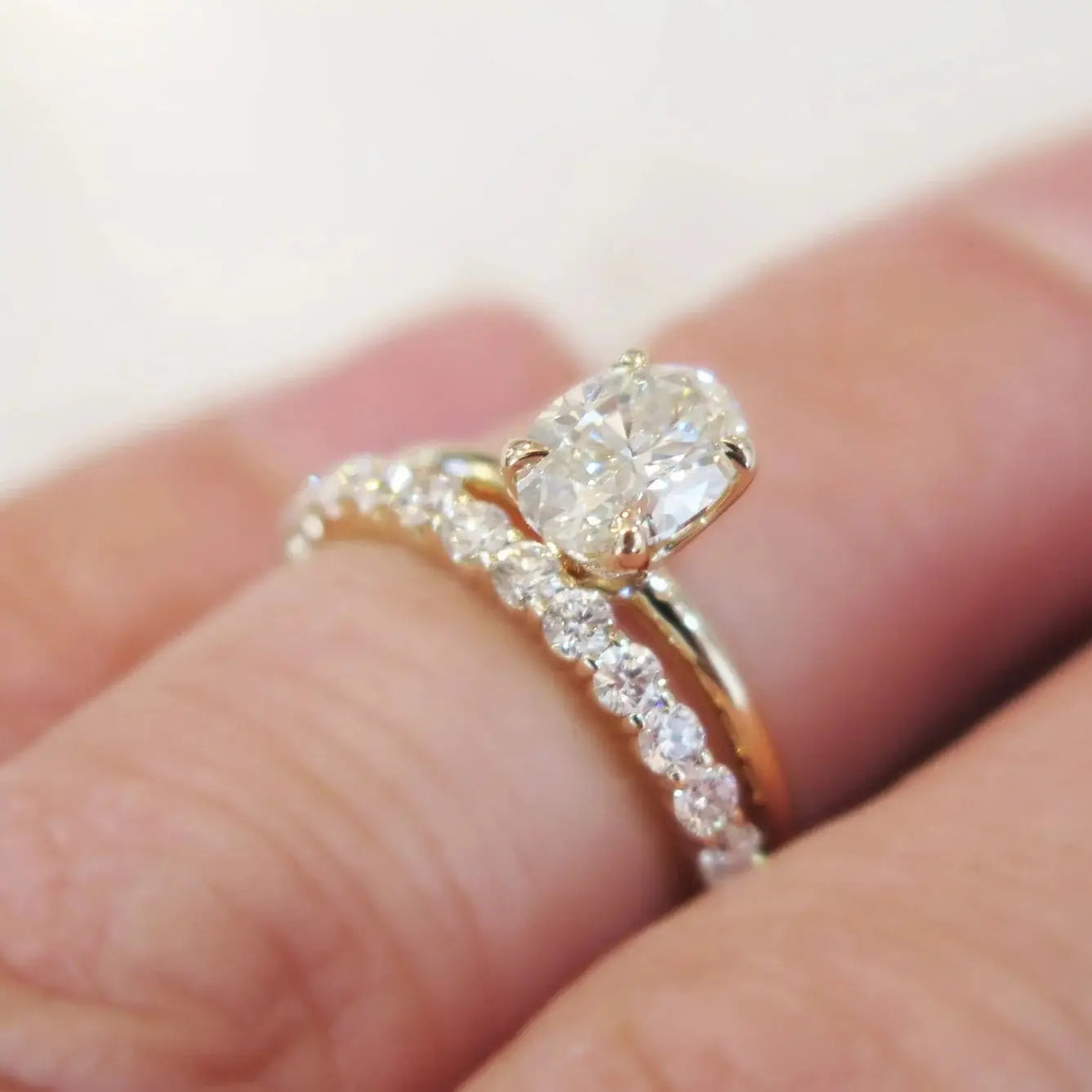
Is Moissanite Worth the Money? A Real Cost Breakdown
Last updated July 2026
"Worth it" is really a financial question, so let's answer it like one. Here's the actual cost of choosing moissanite, not just the sticker price, but insurance, long-term ownership costs, and what the savings genuinely buy you elsewhere in the ring.
The Purchase Price Math
| Stone Size (Diamond Equivalent) | Lab-Grown Diamond | Moissanite |
|---|---|---|
| 1.0 carat | ~$1,000–$3,000 | ~$700–$900 |
| 2.0 carat | ~$2,500–$6,000 | ~$900–$1,600 |
Against a mined diamond of the same specification, often $6,000 to $10,000+ for a single carat, the gap widens further still. The core financial case for moissanite isn't subtle: it's routinely 90% or more cheaper than a comparable mined diamond, and meaningfully less than even a lab-grown diamond of the same visual size.
What Does That Saving Actually Buy You?
This is the part most cost comparisons skip. A few concrete ways that saving typically gets redirected:
- A larger stone at the same budget. Moving from 1ct to 1.5 or 2ct moissanite for what a 1ct mined diamond alone would cost.
- A better setting. Settings cost roughly the same regardless of which stone sits in them, the price driver is metal choice and design complexity, not the gem. Redirecting diamond-level budget into an 18K or platinum setting, or a more elaborate design, is a genuinely common trade couples make.
- A wedding band, or the wedding itself. For couples treating the ring as one line item in a broader budget, rather than the single biggest spend, this matters more than it might seem.
Total Cost of Ownership: Beyond the Purchase Price
A ring isn't a one-time cost, and this is where the moissanite savings compound further.
Insurance. Jewellery insurance typically runs 1 to 2% of a ring's appraised value per year. On a mined diamond ring appraised at $8,000, that's $80 to $160 annually, indefinitely. On a moissanite ring appraised at $1,500, that's $15 to $30. Over a few decades of ownership, that gap adds up to a genuinely meaningful sum, on top of the upfront saving, not instead of it.
Maintenance and resizing. These cost the same regardless of stone, cleaning, prong checks, and resizing are priced on labour and metalwork, not on what's set in the ring. No difference here between moissanite and diamond.
Resale. Worth being honest about: moissanite has minimal resale value as a gemstone, if sold or pawned, you're generally paid for the metal, not the stone. Mined diamonds retain roughly 25 to 50% of retail value; lab-grown diamonds roughly 10 to 30%. This is the one area where diamond, mined in particular, has a genuine financial edge. We've made the fuller case on this specifically in The Truth About Resale Value, including why most buyers shouldn't weight it heavily in the first place.
Is Moissanite Visually "Worth" What You're Paying For?
Financially worth it only matters if the stone actually delivers. At a glance, most people can't distinguish moissanite from diamond. Premium D colour moissanite offers genuinely high brilliance, often more fire than a diamond, thanks to its higher refractive index and dispersion. It does show a more colourful, sometimes described as "disco ball," sparkle under strong direct light, a style difference rather than a quality shortfall. Full detail on the optical comparison is in our diamond vs moissanite guide.
Does It Hold Up Long-Term, or Is This a False Economy?
A cheap stone that needs replacing in a decade isn't actually good value. Moissanite doesn't have that problem: at 9.25 on the Mohs scale, it's durable enough for decades of daily wear, and, in one genuinely underappreciated respect, it has no defined cleavage plane, meaning it resists chipping from a sharp impact even better than diamond does in some circumstances, despite being slightly less hard. Full detail in Will Moissanite Last Forever? This isn't a stone you'll be replacing, the upfront saving isn't offset by a shorter lifespan.
A Note on the Ethics and Environmental Claims
Moissanite is fully lab-created, with a traceable, conflict-free origin, that part is straightforwardly true. We'd stop short of calling it definitively "the lowest environmental impact of the three," though, that kind of blanket claim depends on the specific production process and energy source involved, an area regulators have specifically flagged as prone to overstatement. What's reliably true: no mining, no land disruption, fully traceable sourcing.
The Verdict: Is Moissanite Worth the Money?
For most buyers, yes, decisively. The purchase price saving is real and substantial, it compounds through lower insurance costs over time, and it doesn't come at the cost of durability or visual brilliance. The one genuine financial trade-off is resale value, which is lower than diamond, and worth knowing honestly rather than glossing over. If resale genuinely matters to you, that's a legitimate reason to weight your decision differently. If you're buying a ring to wear and love rather than to eventually sell, the financial case for moissanite is straightforward.
Design Your Moissanite Ring at VYOR Diamond Lab
We offer only D colour, VVS1 moissanite, fully customisable in any cut or size, paired with premium 14K/18K gold or platinum settings. Nikolett and I can walk you through exactly what your budget buys across moissanite, lab-grown diamond, and mined options, so the financial comparison is concrete, not abstract.
Frequently Asked Questions
How much cheaper is moissanite than a diamond? Typically 90% or more cheaper than a comparable mined diamond, and meaningfully less than a similarly sized lab-grown diamond too.
Does moissanite cost less to insure than a diamond? Yes, significantly. Insurance generally runs 1 to 2% of a ring's appraised value annually, so a lower-value moissanite ring costs considerably less to insure than a mined diamond ring of the same visual size, year after year.
Is moissanite a bad investment because of low resale value? Only if you're treating an engagement ring as a financial investment, which most jewellers, us included, would caution against for any stone. If you're buying to wear and love, resale value matters far less than purchase price and long-term durability.
Does choosing moissanite mean a lower-quality setting? No, the opposite is often true. Setting cost is driven by metal and design complexity, not the stone, so moissanite buyers frequently redirect the savings into a better setting than they could otherwise afford.
Is moissanite worth it long-term, or will it need replacing? It's built to last. At 9.25 Mohs hardness and with genuinely strong resistance to chipping, a well-maintained moissanite ring should last decades without needing replacement.
Explore our Moissanite Engagement Ring Collection, or book a consultation at our Wembley showroom for a concrete cost breakdown for your specific budget.
Share:
Do Moissanite Engagement Rings Look Cheap? Honestly, No
Buying a Moissanite Ring: The Complete Buyer's Guide