

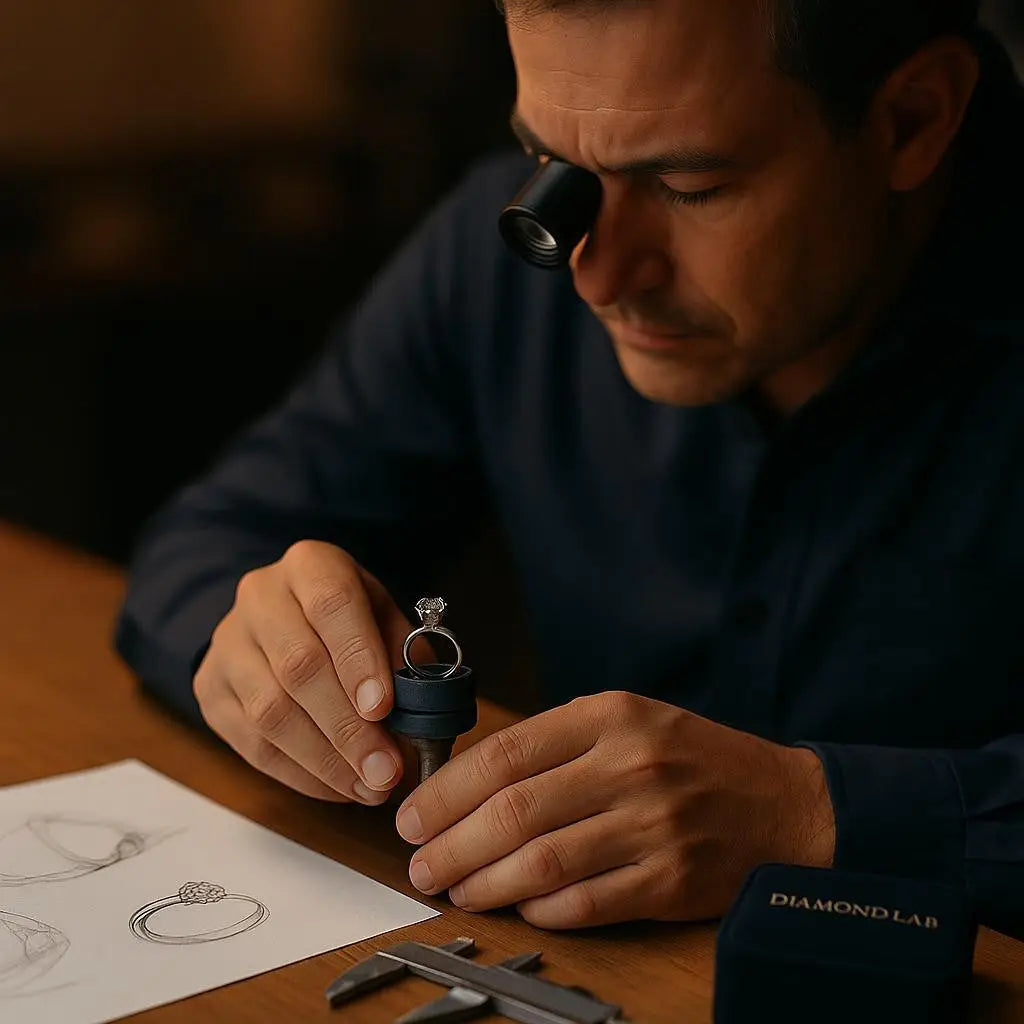
Diamond vs Moissanite: A Clear Side-by-Side Comparison
Last updated July 2026
Both are brilliant, durable, and used constantly in fine jewellery, but diamond and moissanite are genuinely different materials with different strengths. Here's a clear, honest comparison to help you choose with confidence.
What Are Diamonds and Moissanite?
Diamond
- Pure carbon, arranged in a cubic crystal structure
- Naturally formed or lab-grown
- Graded on the 4Cs and certified by IGI or GIA
Moissanite
- Silicon carbide, a genuinely different mineral
- Almost always lab-created today, natural moissanite is extraordinarily rare
- Sold by size and quality tier rather than the 4Cs framework
They can look similar at a glance, but they differ meaningfully in composition and in how they behave under light.
The Key Differences
| Diamond | Moissanite | |
|---|---|---|
| Composition | Carbon | Silicon carbide |
| Hardness (Mohs) | 10 | 9.25 |
| Refractive index | 2.42 | 2.65–2.69 |
| Brilliance character | Classic white sparkle | More fire, rainbow flashes |
| Price | Higher | Roughly 90% less per carat |
| Origin | Mined or lab-grown | Almost always lab-created |
| Ethical sourcing | Lab-grown: fully traceable. Mined: varies | Fully traceable by default |
| Certification | IGI/GIA graded on the 4Cs | Typically sold with a brand or lab certificate of authenticity, we use IGI or GIA for our lab diamonds and issue our own certificate for moissanite |
For the physics behind the brilliance difference (refractive index, dispersion, and why moissanite shows more fire), see our full breakdown in Is Moissanite a Good Choice for Engagement Rings?
How Do They Actually Look, Side by Side?
From across a room, telling them apart is genuinely difficult. Up close, under strong lighting or magnification, some differences emerge:
Diamond returns more classic white light, reads as crisp and clear, and delivers the timeless, familiar sparkle most people associate with "diamond."
Moissanite shows noticeably more fire, visible rainbow flashes rather than pure white light, particularly under direct sunlight. In some cuts this reads as bold and striking; in others, particularly older or less precise cuts, it can look busier than some buyers want. It's a genuine style difference, not a quality defect either way.
Cost Comparison: The Real Numbers
Moissanite is dramatically more affordable, though it's worth using realistic current figures rather than inflated ones:
| Size | Lab-Grown Diamond (D–F, VS+) | Moissanite (premium grade) |
|---|---|---|
| 1.0 carat | Roughly $1,000–$3,000 | Roughly $300–$900 |
| 2.0 carat | Roughly $2,500–$6,000 | Roughly $700–$1,500 |
These are indicative ranges, actual pricing depends on the specific cut, clarity and colour grade, but the proportional gap holds: moissanite typically runs a fraction of the cost of a comparable lab-grown diamond, which is the entire basis of its appeal for many buyers. That difference can go toward a larger stone, a more elaborate setting, or simply staying comfortably within budget.
Durability and Longevity
Diamond is the hardest natural material, a full 10 on the Mohs scale. Moissanite sits at 9.25, still exceptionally durable, well above sapphire and ruby, and genuinely suited to daily wear for decades. In practice, the difference in day-to-day scratch resistance between the two is rarely noticeable to the wearer; both handle normal daily knocks, impacts and cleaning without issue. Diamond's edge here matters more in extreme or industrial contexts than in everyday jewellery wear.
Which Is More Ethical?
Both are strong, genuinely ethical choices, with one honest caveat:
Moissanite: always lab-created, no mining, no conflict-zone sourcing risk.
Lab-grown diamonds: conflict-free, fully traceable, IGI or GIA certified.
We'd stop short of saying moissanite is definitively "more ethical" on environmental grounds specifically, both are manufactured products, and the environmental footprint of either depends significantly on the energy used in production, an area where blanket claims tend to overreach what the evidence actually supports. Where moissanite does have a clearer edge is sourcing simplicity: there's no natural-origin ambiguity to navigate at all, whereas a mined diamond alternative would carry that consideration.
How to Choose Between the Two
Choose moissanite if:
- Maximum sparkle on a considered budget is the priority
- You're drawn to a bolder, more fire-forward look
- You want the simplest possible ethical sourcing story
- You're designing something fashion-forward or statement-led
Choose a lab-grown diamond if:
- You want the classic, traditional stone people instinctively recognise
- You prefer crisp, white brilliance over pronounced fire
- Resale value or a more diamond-specific heirloom story matters to you, worth reading our honest take on resale value either way
- The idea of "diamond" specifically carries meaning for you, independent of visual comparison
Our Recommendation
We offer both lab-grown diamonds and premium D colour, VVS1 clarity moissanite, because the right choice genuinely depends on the person, not a universal ranking. We'd always recommend seeing both in person before deciding: some people fall for moissanite's fire immediately; others feel strongly drawn to a diamond the moment they see one, and a comparison chart won't tell you which you'll be.
Compare Them with Us at VYOR Diamond Lab
Nikolett and I set both side by side at every consultation where it's relevant, no pressure toward either, just an honest look under real lighting so you can decide based on what you actually see and feel, not just what's on a spec sheet.
Frequently Asked Questions
Is moissanite as good as a diamond? It's a different, genuinely excellent gemstone in its own right, not a lesser version of diamond. It's more affordable and shows more fire; diamond is harder and shows more classic white brilliance. "Better" depends on what you're after.
How much cheaper is moissanite than a lab-grown diamond? Typically around 90% less per carat for a comparable size and quality tier.
Can you tell moissanite apart from a diamond by eye? Often, yes, with practice, particularly under strong direct light, where moissanite's extra fire becomes more visible. From a distance or in everyday indoor lighting, the difference is far less noticeable.
Is moissanite more ethical than a lab-grown diamond? Both are traceable, conflict-free options. Moissanite has a simpler sourcing story since there's no natural-origin question at all; broader environmental impact for either depends on the specific production process rather than favouring one material outright.
Which holds its value better, diamond or moissanite? Diamond, generally, particularly mined diamond. If resale value is a genuine priority, that's worth weighing directly rather than assuming either option performs like a financial investment.
Explore our Engagement Ring Collection, featuring both lab-grown diamonds and premium moissanite, or book a consultation at our Wembley showroom to compare them side by side.
Share:
Moissanite vs Lab-Grown vs Mined Diamonds: Full Comparison
Brilliant vs Crushed Ice Moissanite: Which Sparkle Is You?