

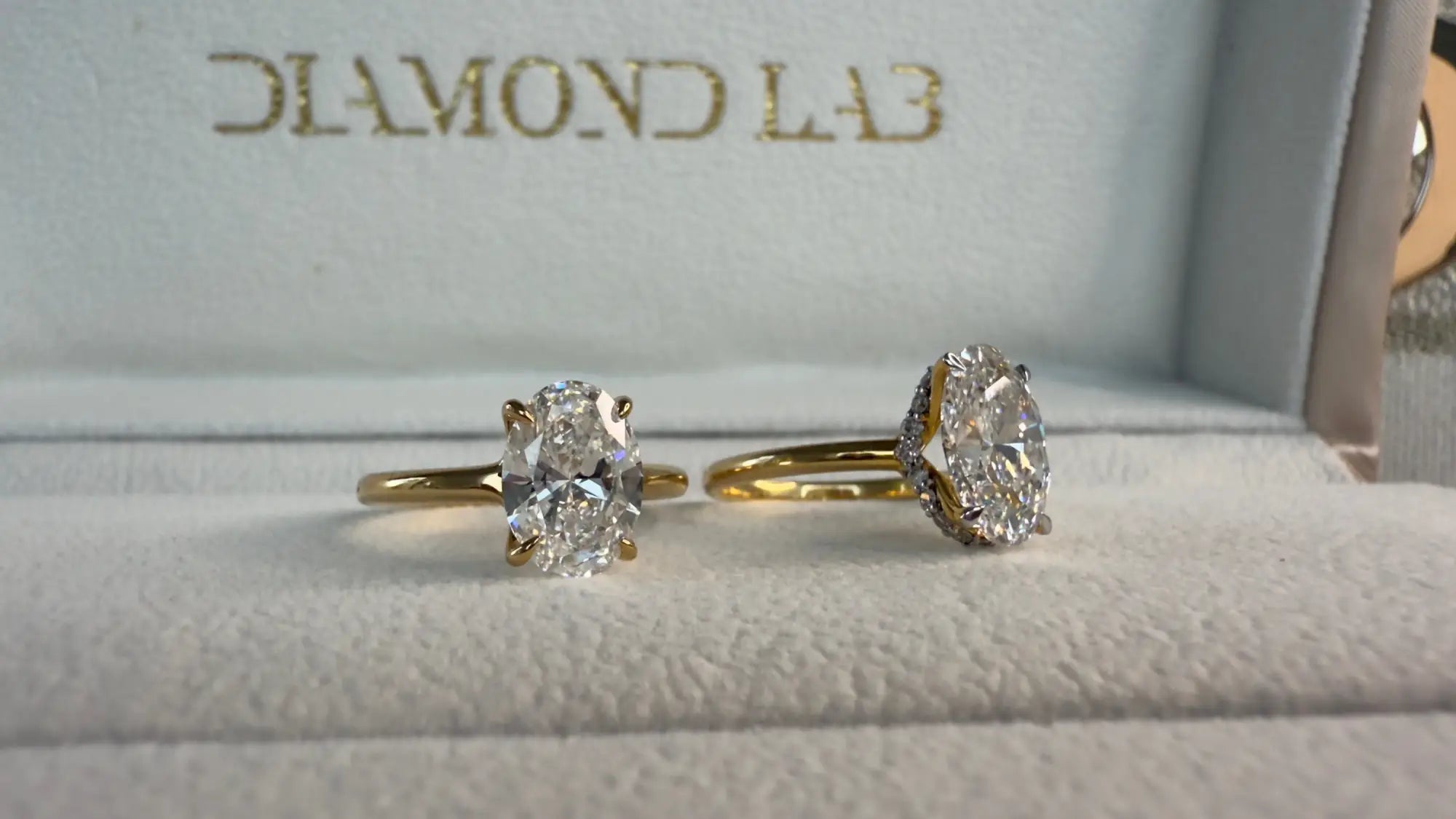
How to Tell Moissanite From a Diamond: The Real Tests
Last updated July 2026
Here's a genuinely surprising fact: a basic diamond tester will identify moissanite as a diamond, every time. That's not a flaw in the stone or a trick, it's physics, and understanding why reveals exactly how jewellers, gemologists and insurers actually verify what they're looking at.
Why Basic Diamond Testers Get Fooled
Most handheld diamond testers work by measuring thermal conductivity, how quickly a stone pulls heat away from a metal probe. Diamond is an exceptional heat conductor, historically better than almost anything else a jeweller might encounter, which is why this became the standard test for decades.
The problem: moissanite conducts heat almost identically to diamond. When early moissanite entered the market in the late 1990s, it passed basic thermal testers as "diamond" immediately, not through any deception, but because the physical property being measured genuinely doesn't distinguish the two materials.
The Real Test: Electrical Conductivity
This is where the two materials genuinely diverge. Diamond is, with one rare exception below, an electrical insulator, electricity doesn't pass through it. Moissanite, silicon carbide, is a semiconductor, the same class of material used in electronics specifically because it conducts electricity.
Modern multi-testers run both checks: a thermal probe first (which both stones pass), followed by an electrical conductivity test. Moissanite conducts that current; diamond doesn't. That second test is what correctly flags moissanite, and it's the reason any jeweller doing this professionally uses a multi-tester rather than a basic thermal-only unit.
The Rare Wrinkle Worth Knowing
Two nuances keep this from being perfectly foolproof, worth knowing if you want the full picture:
- Type IIb natural diamonds, roughly 2% of natural diamonds, contain trace boron, which makes them electrically conductive too, occasionally producing a false "moissanite" reading on an electrical tester.
- Some newer moissanite is manufactured with deliberately reduced electrical conductivity, low enough to occasionally read "diamond" even on a sensitive electrical tester.
Neither undermines the general rule, they're genuine edge cases, but they're exactly why a single tester reading is treated as an indicator, not a final verdict, by anyone doing this professionally.
The Loupe Test: Double Refraction
This is the most reliable visual method, and you don't need electronics for it. Moissanite is doubly refractive, light entering the stone splits into two separate rays, which creates a visible doubling of facet edges when viewed under 10x magnification. Diamond is singly refractive and shows crisp, single, undoubled lines.
How to actually look for it: view through a crown or pavilion facet at an angle, not straight down through the table, doubling is much harder to spot from directly above. It's also considerably easier to see in some shapes than others, round and oval stones show it fairly readily; emerald cuts can make it extremely difficult to detect, and modern precision-cut moissanite is increasingly cut specifically to minimise this effect, which is worth knowing if a loupe check looks inconclusive.
Other Visual Clues Worth Knowing
- Fire and colour. Moissanite consistently shows more colourful, rainbow-heavy sparkle than diamond, a direct result of its higher dispersion. It's not definitive on its own, cut quality affects both stones, but it's a reasonable first indicator.
- Girdle finish. Diamonds most commonly have a faceted girdle; moissanite sometimes has a smooth, polished girdle instead. Again, not conclusive alone, but a genuine clue worth checking alongside everything else.
The Certificate Check
The most straightforward method of all, if the stone is certified: diamonds are typically laser-inscribed on the girdle with a unique report number, visible only under magnification, which you can verify against the certificate and the issuing lab's own database. Moissanite isn't individually numbered the same way diamonds are, so a certificate mismatch, or the absence of any inscription where one should exist, is itself informative.
Why Any of This Actually Matters
A few genuine reasons this isn't just trivia: confirming a stone matches its certificate before a purchase, verifying an inherited or secondhand piece before insuring it, or simply satisfying honest curiosity about a stone you already own and love. None of this is about "catching out" moissanite, it's a legitimate, valuable gemstone in its own right, it's about knowing precisely what you have.
How We Handle This at VYOR Diamond Lab
Every stone we sell, lab-grown diamond or moissanite, comes with clear, accurate certification, so you never need to run these tests yourself to know exactly what you're wearing. Nikolett and I disclose origin plainly at every consultation, and we're genuinely happy to walk you through a loupe demonstration if you're curious to see the physics described above in person.
Frequently Asked Questions
Does moissanite pass a diamond tester? On a basic thermal-only tester, yes, every time, since moissanite conducts heat almost identically to diamond. A modern multi-tester, which also checks electrical conductivity, correctly identifies it as moissanite.
Why does moissanite conduct heat like a diamond but not electricity? Thermal and electrical conductivity are separate physical properties. Moissanite happens to share diamond's excellent heat conductivity, but as a semiconductor, it also conducts electricity, which diamond generally doesn't.
Can you see the difference between moissanite and diamond with a loupe? Often, yes. Moissanite shows double refraction, doubled facet edges, when viewed at an angle through a crown or pavilion facet under 10x magnification. Diamond shows single, crisp lines. It's harder to spot in emerald cuts and in modern precision-cut moissanite designed to minimise the effect.
Are diamond testers ever wrong about moissanite? Occasionally, in both directions. Rare boron-containing natural diamonds (Type IIb, about 2% of natural diamonds) can read as "moissanite" on an electrical tester, and some newer low-conductivity moissanite can occasionally read as "diamond." These are genuine edge cases, not the norm.
What's the most reliable way to confirm a stone's identity? A certified grading report from IGI or GIA, cross-checked against the laser inscription on the stone itself, remains the most definitive method, more reliable than any handheld tester alone.
Explore our Moissanite and Lab-Grown Diamond Collection, or book a consultation at our Wembley showroom, every stone comes with clear, honest certification from the start.


Share:
Do Moissanite Engagement Rings Look Cheap? Honestly, No
Buying a Moissanite Ring: The Complete Buyer's Guide