

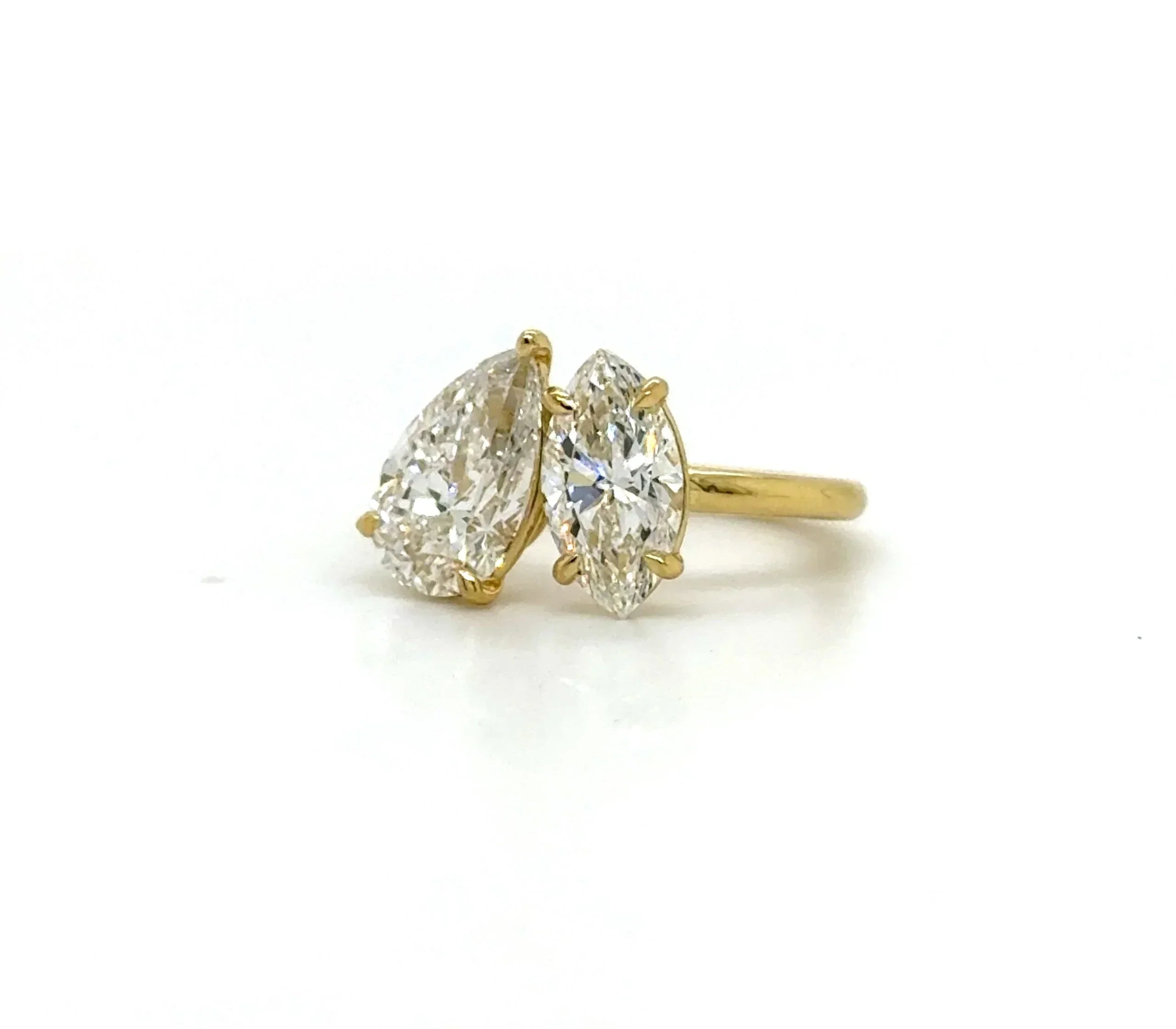
The Toi et Moi Engagement Ring: Two Stones, One Love Story
Some love stories are too layered for a single stone to carry. That's really the whole premise of a Toi et Moi ring, French for "you and me", two gemstones set side by side, each one standing for a person rather than a single idea of "the diamond." It's an old idea, genuinely centuries old, and it still feels strikingly modern every time we design one.
The Actual History, Not Just the Highlight Reel
The style is usually traced to 1796, when Napoleon Bonaparte proposed to Joséphine de Beauharnais with a ring pairing a pear-shaped sapphire and a pear-shaped diamond, nestled together rather than one stone dominating the other. What's worth knowing beyond the highlight-reel version: this wasn't a passing gesture. The two-stone motif kept resurfacing across European jewellery for the next two centuries, worn at various points by women whose choices genuinely shaped bridal fashion, and it's had a fresh resurgence in the past several years as more couples look past the standard solitaire script.
It's not an "old-fashioned" style dusted off for nostalgia. It's one of the more genuinely personal formats available, because the meaning isn't fixed the way a single centre stone's symbolism tends to be.
What Actually Makes This Setting Different
A conventional engagement ring puts everything on one stone. Toi et Moi splits that weight across two, and that opens up real creative range:
- Two different cuts — an oval beside an emerald, a pear beside a radiant, contrast rather than repetition
- Two different materials — a lab-grown diamond beside moissanite, or a coloured birthstone beside a white stone
- Two different scales — equal-sized stones, or one clear centrepiece with a smaller companion stone
The meaning is genuinely yours to assign: two people, two moments, two versions of the same story sitting side by side rather than competing.
Pairing Stones Well: What We'd Actually Tell You
A few combinations we see clients gravitate toward, and why they tend to work:
Lab-grown diamond + moissanite — similar brilliance with a genuine point of contrast in how each catches light. Worth knowing before you commit to this pairing specifically: diamond sits at 10 on the Mohs hardness scale, moissanite at 9.25. Over decades of daily wear that gap is rarely noticeable, but if you're someone who's genuinely hard on jewellery, it's worth mentioning during your consultation so we can weight the setting, prong height, protective framing, accordingly, rather than treating both stones identically.
Emerald cut + oval cut — a structured, geometric shape beside a softer, rounded one. This is one of the more visually balanced pairings we design, since the contrast in outline does a lot of the design work on its own.
Pear + round — a flowing, teardrop shape beside classic symmetry, genuinely striking without needing anything else added.
Two moissanites, different shapes — a bold, high-impact look at a considerably more accessible price point than an equivalent two-diamond piece.
Lab-grown diamond + birthstone — colour and personal meaning alongside classic white brilliance, popular for couples who want something a little more specific to their own story.
If you want both stones reading with matched brilliance, stay within one cut family, two brilliant cuts, or two step cuts, rather than mixing philosophies. If contrast is actually the goal, pairing a step cut like emerald against a brilliant cut like oval or cushion tends to read as intentional rather than mismatched.
Browse our lab-grown diamond engagement rings and moissanite engagement rings for stone and style inspiration.
Setting Styles Worth Knowing
Twist band — the band curves and flows around each stone rather than holding them in a straight line, genuinely romantic in feel.
Floating stones — a minimal claw setting that lets both gems appear to hover just above the finger, striking in its simplicity.
Bypass setting — the band splits and arcs around each stone independently, creating an open, airy silhouette between them.
Bezel or half-bezel — sleek and more protective, a sensible choice if either stone is on the softer side or you want extra security for daily wear.
We use claw prongs across all of these, never the bulkier traditional prong styles, since they hold each stone securely while letting genuinely more light reach it from the sides.
Designing Your Own
This isn't a preset-list decision, it's closer to co-designing something from scratch. You'll choose stone type (lab-grown diamond, moissanite, or a combination), shape for each stone, metal (14K or 18K gold in yellow, white or rose, or platinum), band style, and profile height and width. A hidden third stone or birthstone accent inside the band is a genuinely popular final touch for people who want one more layer of personal meaning nobody else will necessarily notice.
CAD renderings let you approve every detail before anything goes into production.
For a starting point, browse our full engagement ring collection — or if you need something sooner, see our ready-to-ship engagement rings.
Frequently Asked Questions
What does "Toi et Moi" actually mean?
French for "you and me." Two gemstones set side by side, historically read as two individuals joined in one piece, rather than a single stone standing in for the relationship.
Is a two-stone setting durable for daily wear?
Yes, particularly with secure claw prongs and quality materials. If you're pairing stones of different hardness, mention it during design so the setting can be adjusted to protect the softer stone appropriately.
How long does a custom Toi et Moi ring take?
Lab-grown diamond designs typically take around 40 days from CAD approval; moissanite designs are often ready in 2 to 3 weeks.
Can I use coloured gemstones in a Toi et Moi ring?
Absolutely, birthstones, sapphires, emeralds, and coloured diamonds are all popular choices for personalising one side of the design.
Is a Toi et Moi ring more expensive than a solitaire?
Not necessarily. Cost comes down to the specific stones and sizes chosen, moissanite pairings in particular can keep this style genuinely affordable.
When One Stone Isn't Quite Enough
A Toi et Moi ring isn't a passing design trend, it's a genuinely old idea that keeps resurfacing because it does something a single stone can't: hold two separate parts of a story in the same piece, side by side, without asking one to represent the other.
Ready to begin designing? Book a consultation at our Wembley showroom or online.
Share:
How to Design a Custom Engagement Ring
Do Engagement Rings Have to Be Diamonds? A Modern Guide to Meaningful Alternatives