


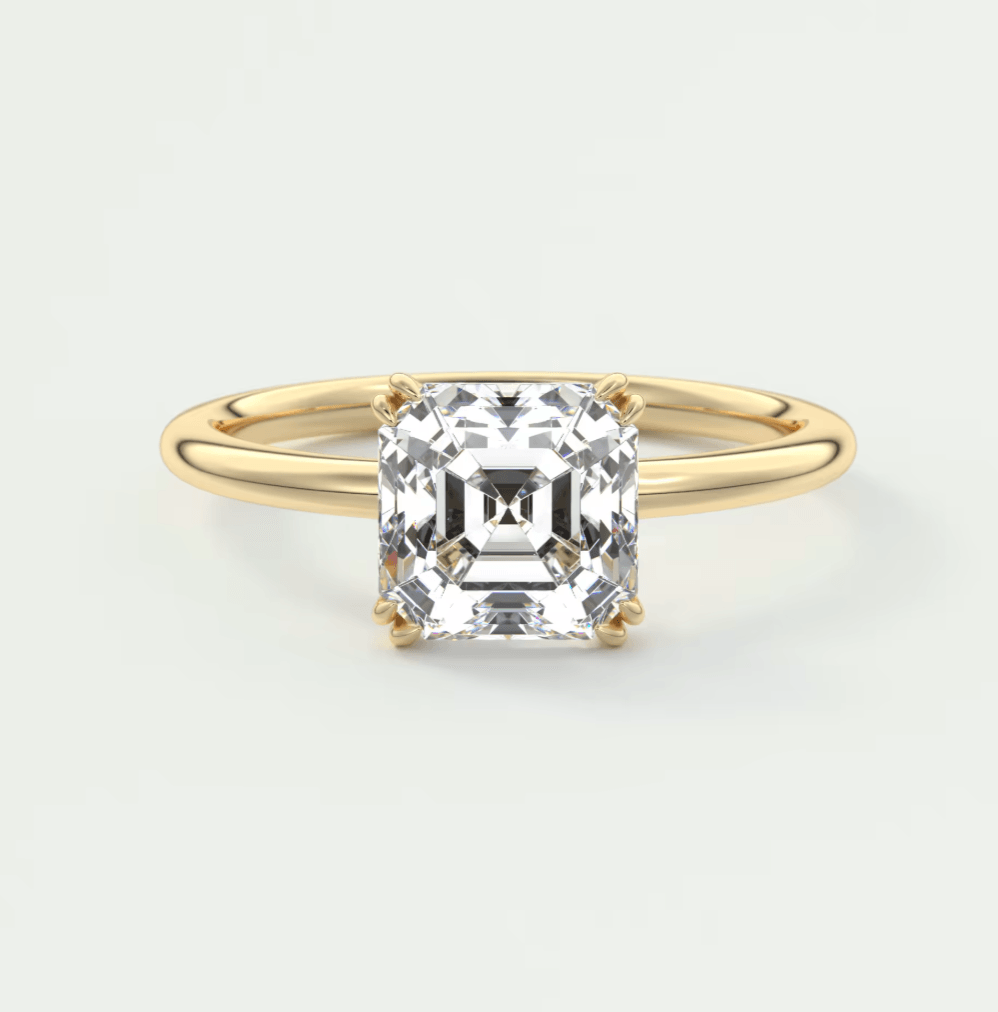
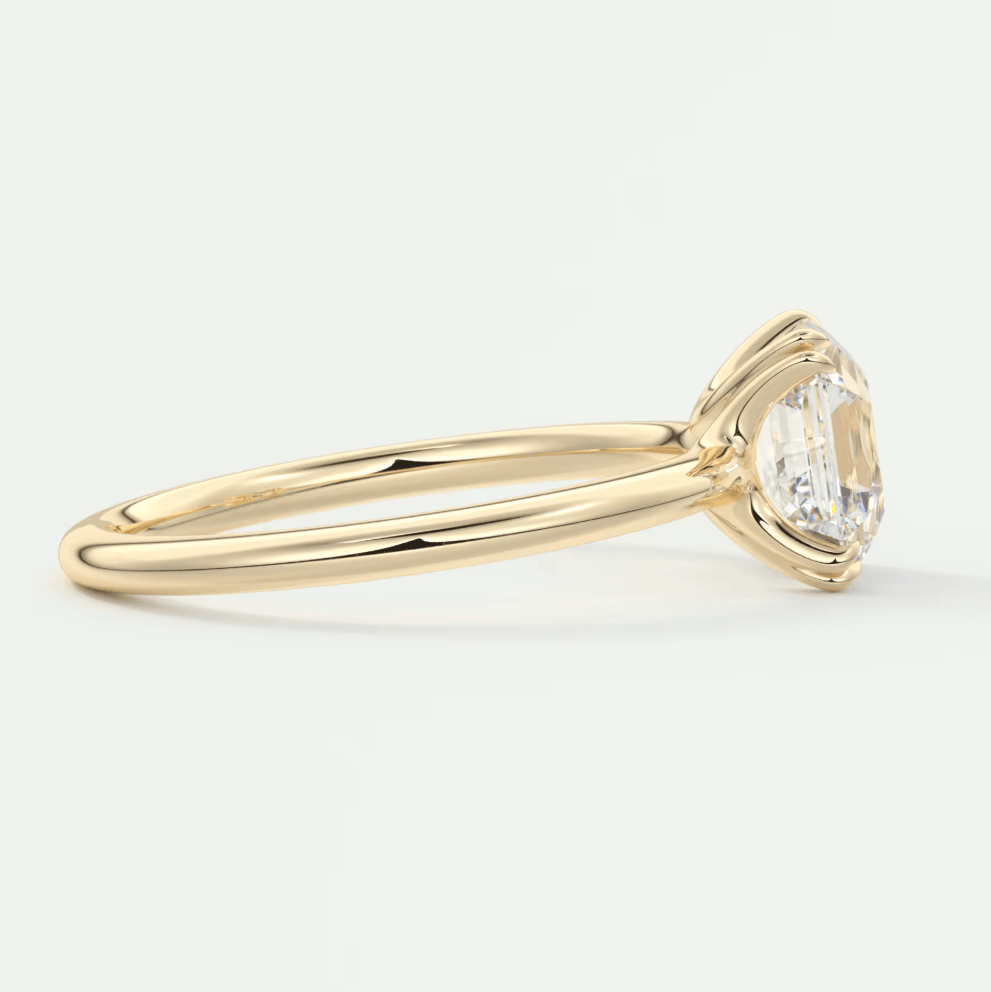
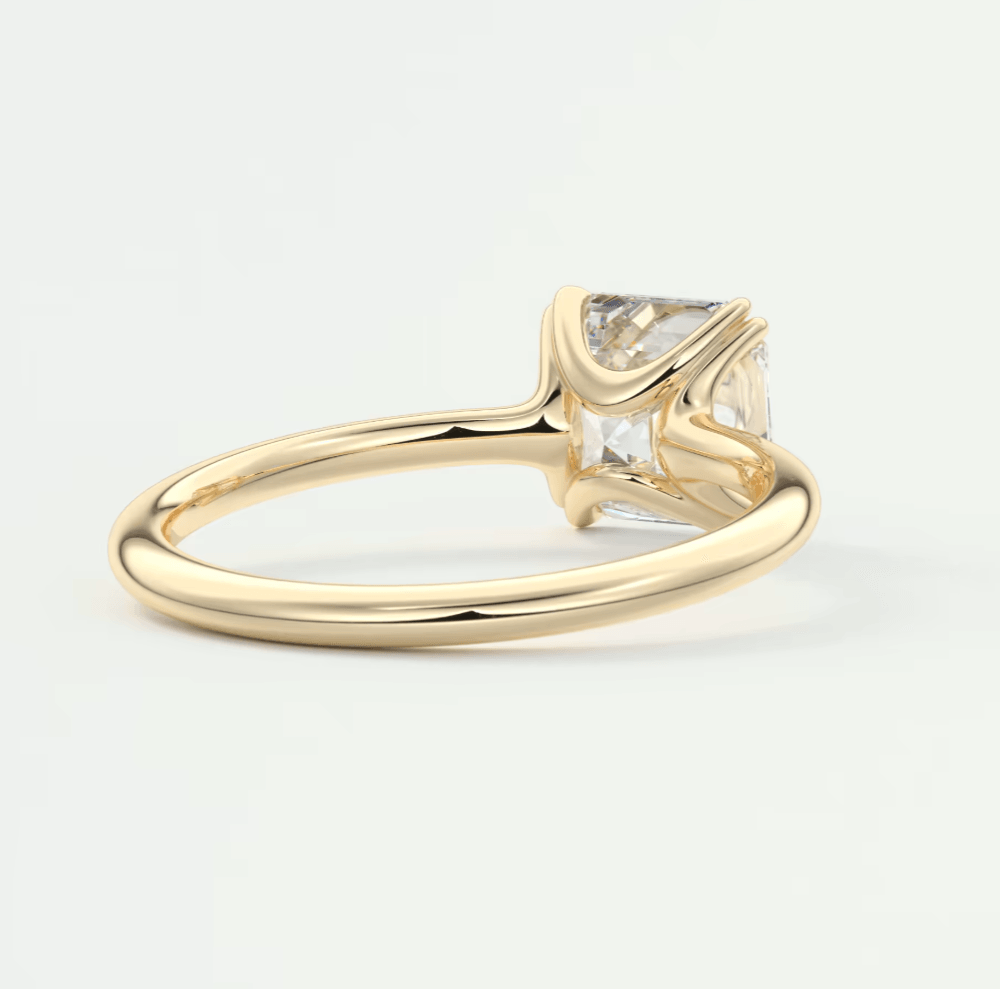
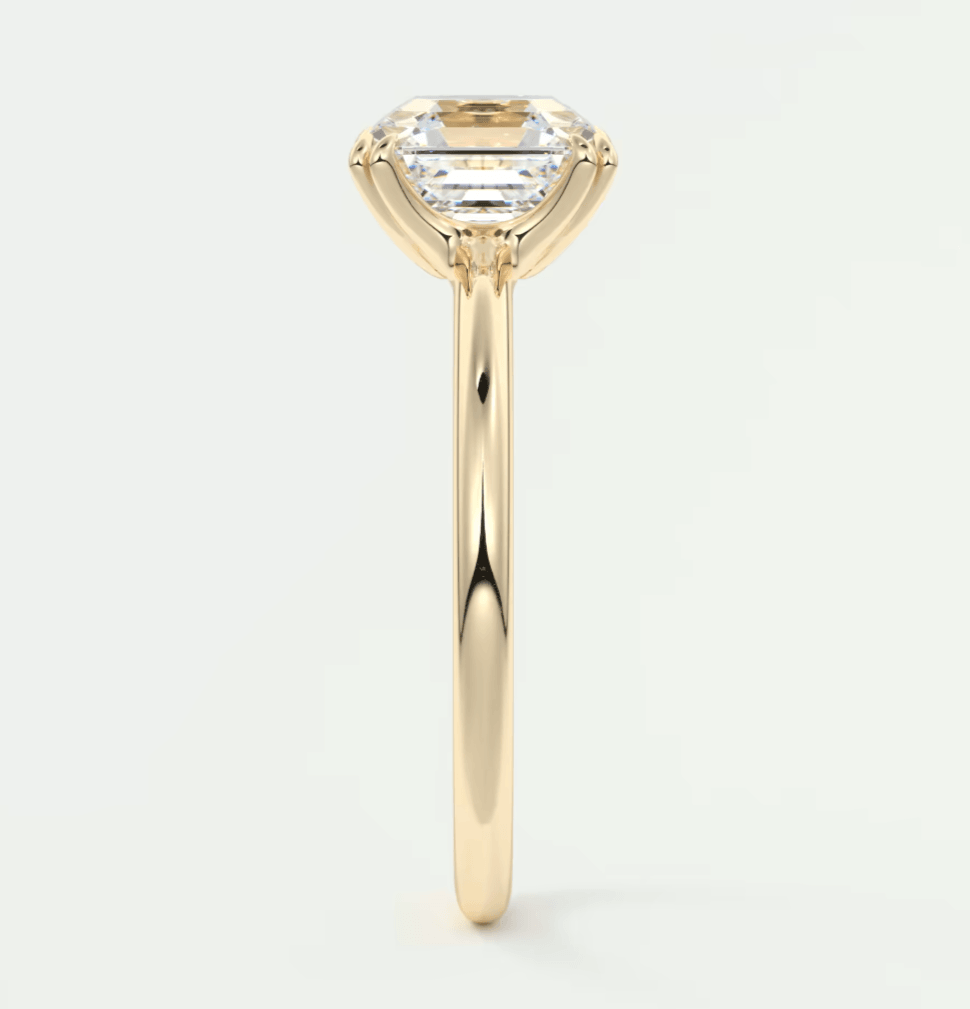
Aura Glide Asscher Double Prong Solitaire Engagement Ring
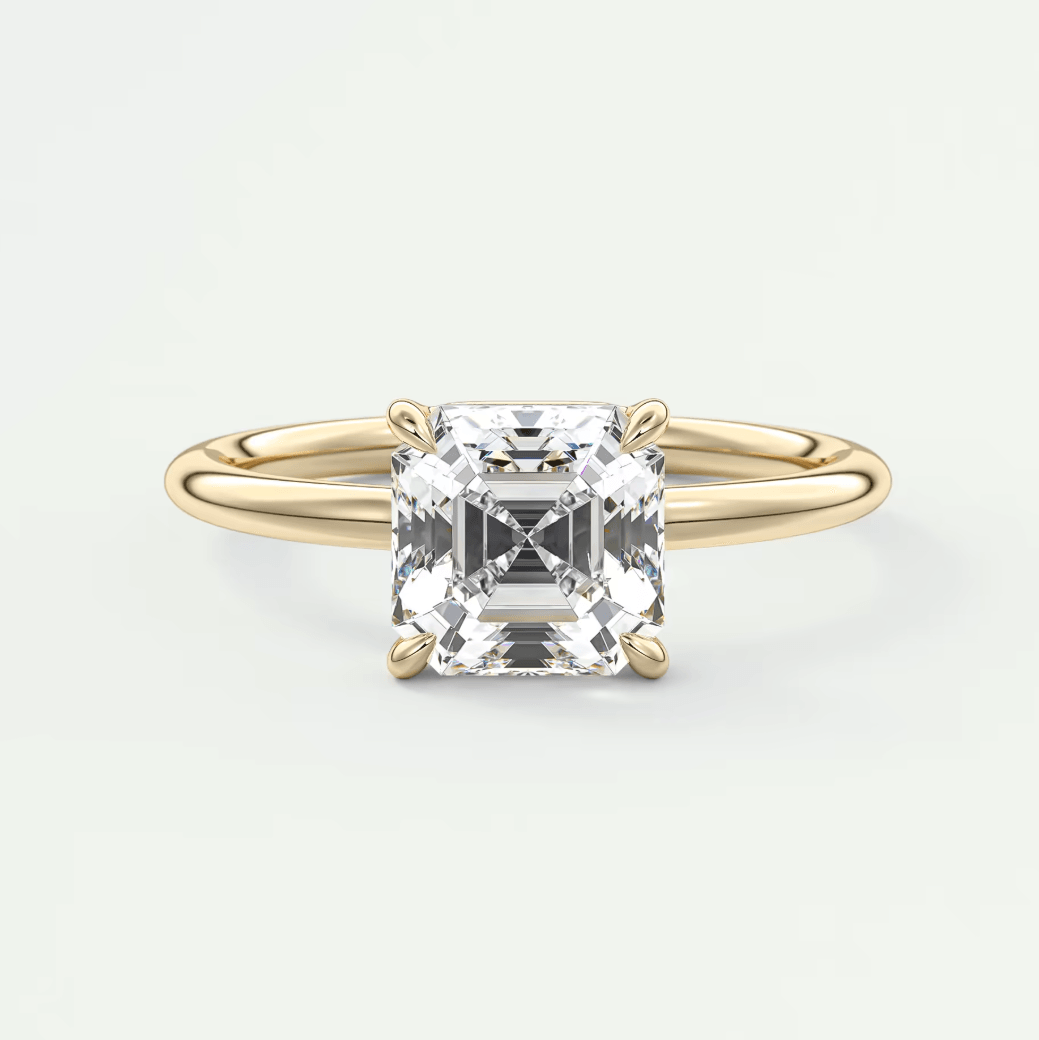
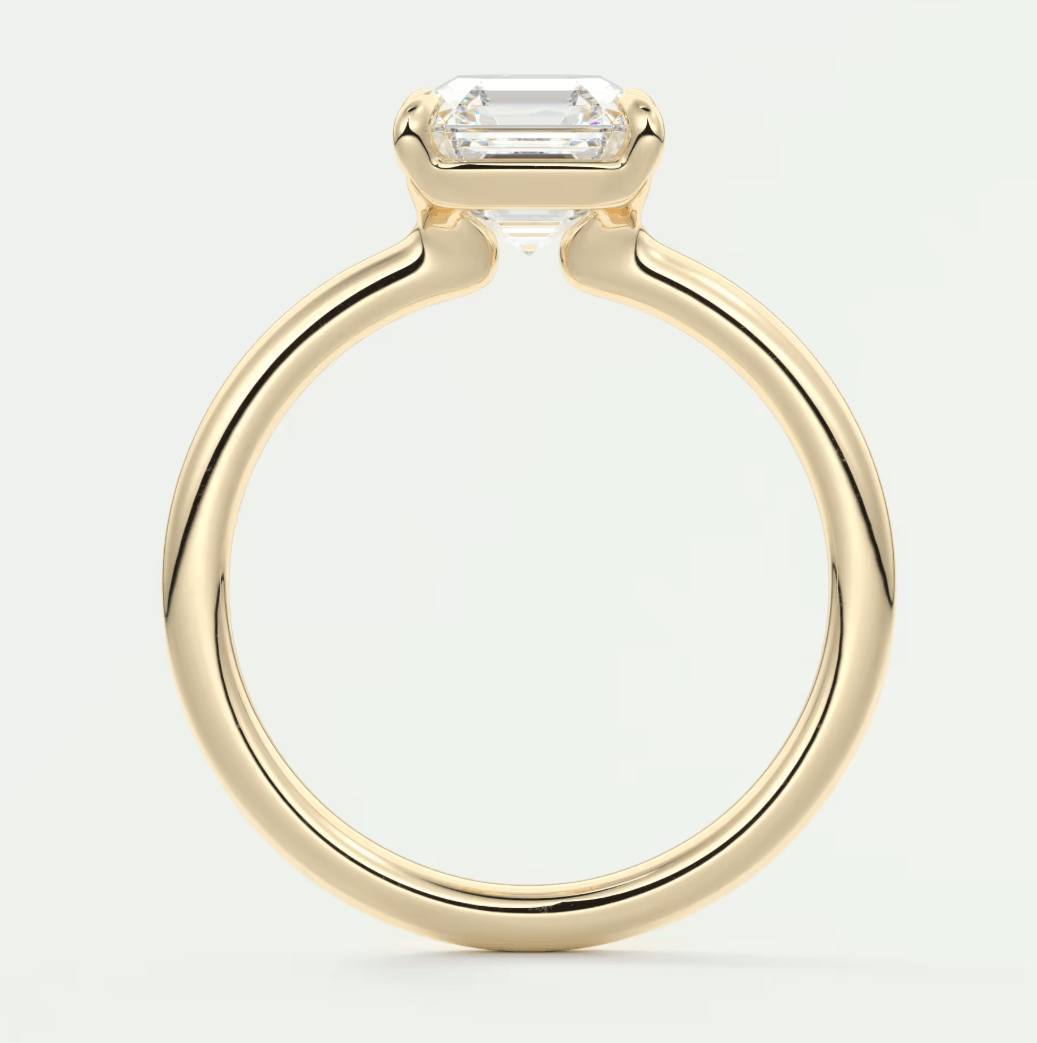
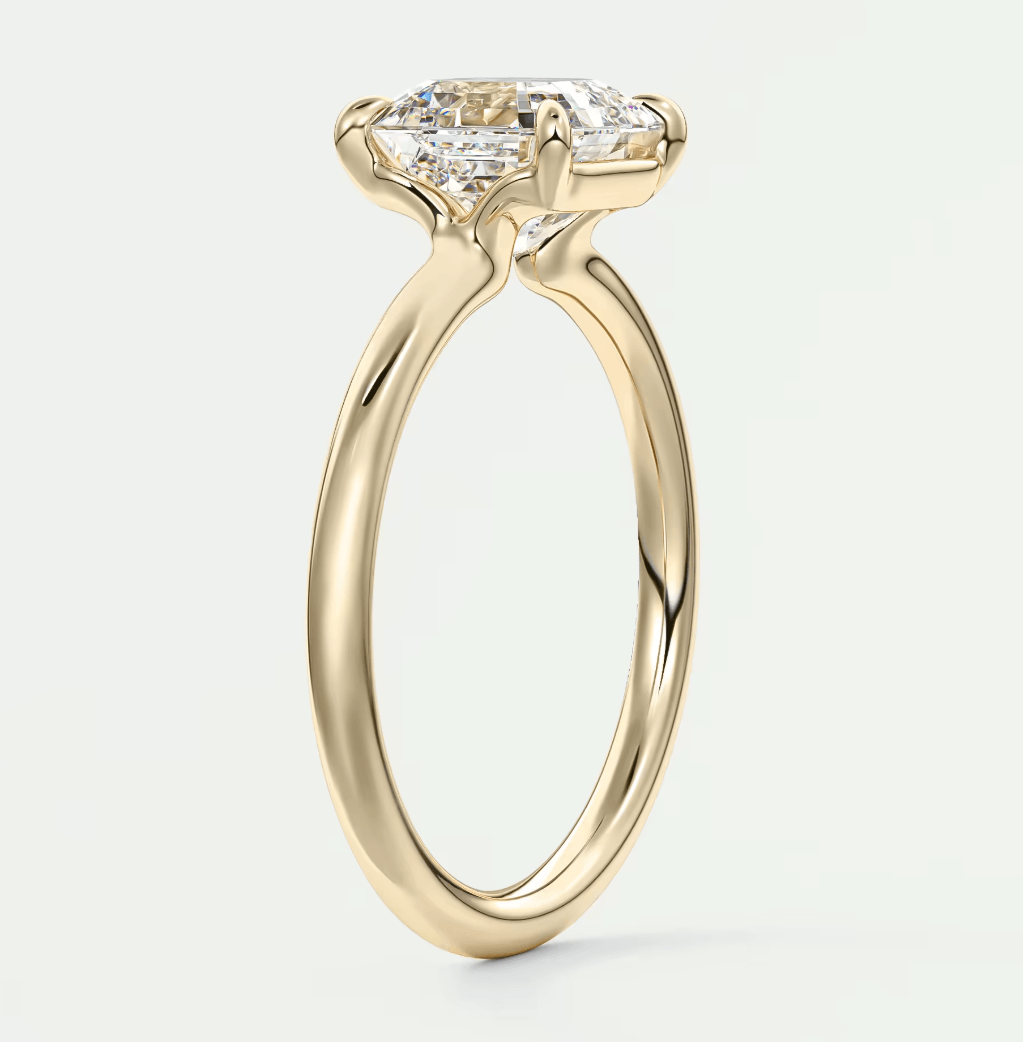
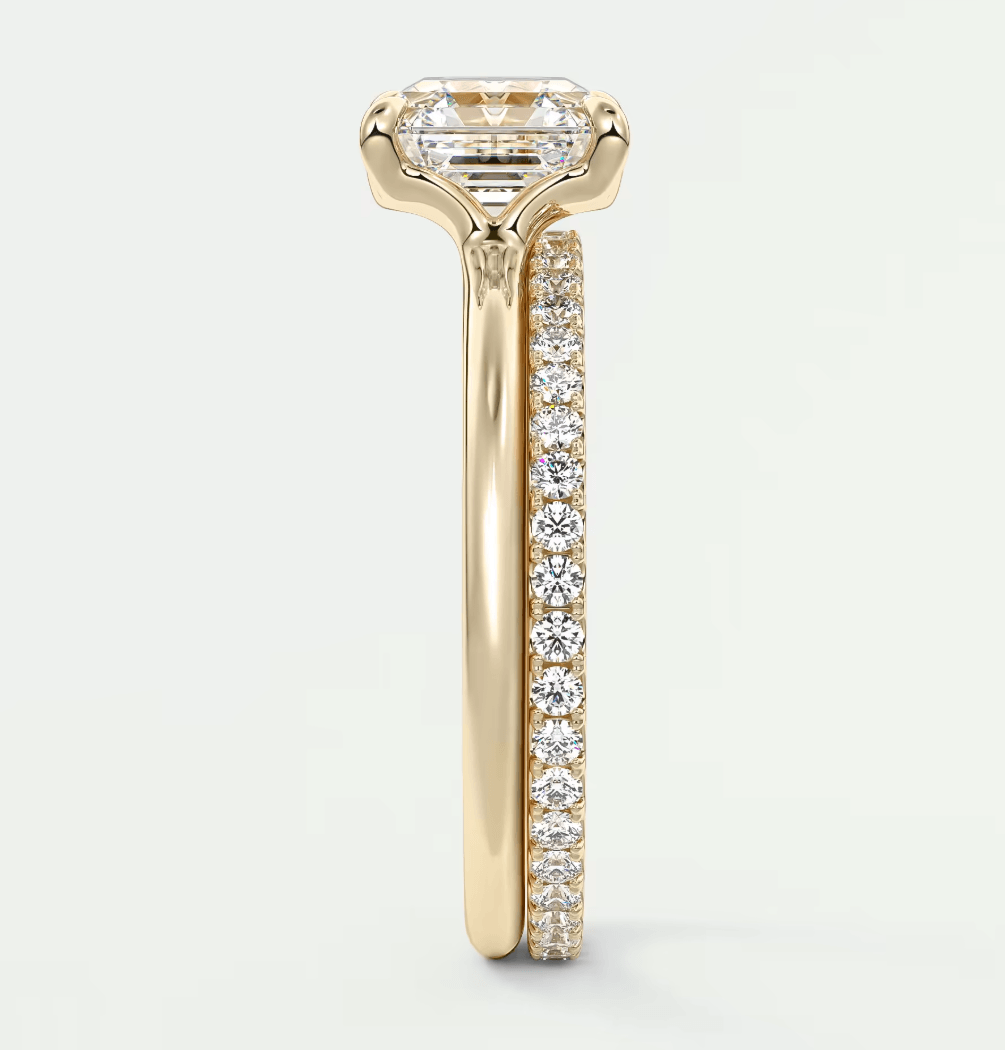
Elysian Asscher Solitaire Engagement Ring
Everything you need to know about the Asscher cut.
Asscher Cut FAQs
What is an asscher cut diamond?
The asscher cut is a square step cut diamond with cropped corners that create a nearly octagonal outline. The cut was patented in 1902 by Joseph Asscher of the Asscher Brothers diamond company in Amsterdam, making it one of the few diamond cuts in history to be patented. Asscher features long, parallel step facets arranged in tiers (similar to emerald cut but in a square format), and the high crown and small table produce a distinctive windmill or hall of mirrors pattern visible when looking down at the stone. Modern asscher cuts have 58 facets and remain one of the most sought after step cut shapes for engagement rings.
What is the difference between an emerald cut and an asscher cut?
The two cuts share the same step facet architecture and the same hall of mirrors light effect, but differ in shape and crown geometry. Emerald cut is rectangular with a length to width ratio of 1.30 to 1.60, while asscher is square at 1.00 to 1.05. The asscher has a higher crown and smaller table than emerald, which produces a more pronounced three dimensional appearance and a stronger windmill pattern. The choice between the two is primarily aesthetic: emerald reads more elongated and architectural, asscher reads more compact and geometric.
What is the windmill or hall of mirrors effect?
When you look directly down at the table of an asscher cut, the long step facets reflect each other in a series of nested squares, creating the impression of looking into an infinite mirror or a slowly rotating windmill. This effect is unique to step cut diamonds and is one of the defining features of asscher cut. It produces a calmer, more contemplative quality of light than the bright scintillation of a brilliant cut, which many clients prefer for its sophistication. The clarity and symmetry of the cut directly determine how clean the windmill pattern appears.
What is the difference between Standard Asscher and Royal Asscher?
Standard asscher is the classic 58 facet design used widely across the industry. Royal Asscher is a modern variant patented in 2001 by descendants of the Asscher family, featuring 74 facets arranged for greater brilliance and a more pronounced windmill effect. Royal Asscher stones are only produced by licensed cutters and carry a Royal Asscher certificate alongside the GIA or IGI grading. VYOR offers both standard asscher and Royal Asscher options. Our gemologist guides clients toward the right choice based on aesthetic preference and stone availability within budget.
Why does clarity matter so much for asscher cut?
The wide step facets and open table of an asscher cut act as a clear window directly into the stone, exposing inclusions that brilliant cuts would hide under their facet pattern. An SI clarity asscher will often show visible inclusions to the naked eye, even though the same grade would face up clean in a round brilliant. VYOR holds the minimum clarity floor at VS1 for every asscher cut, and our gemologist reviews the inclusion plot on every shortlisted stone to ensure inclusions sit toward the edges rather than under the table.
What setting style works best for an asscher cut?
Asscher suits a refined, geometric range of settings. The four claw solitaire (often with double claws at each corner) is the most classic and the most flattering to the square outline, producing a clean Art Deco silhouette. Bezel settings frame the asscher's cropped corners with a sleek metal border. Three stone settings with trapezoid or tapered baguette side stones are a heritage asscher arrangement that pairs especially well, evoking the 1920s Art Deco era when asscher was at its peak popularity. Hidden halo settings add subtle sparkle without distracting from the step cut clarity of the centre stone.
Is asscher cut more or less expensive than round brilliant?
Asscher is typically 20 to 30% less expensive per carat than a round brilliant of equivalent grade, due to better rough utilisation during cutting. However, because clarity matters more for asscher than for round, the practical price difference can narrow once you account for the higher clarity grades VYOR requires for step cuts (VS1 and above with favourable inclusion placement). For clients drawn to the asscher aesthetic, the price advantage versus round is real but modest, and the visual identity is entirely different.
Does VYOR offer asscher engagement rings in moissanite?
Yes. Every VYOR asscher cut design is available in lab grown diamond or D colour, VVS1 clarity moissanite. The D VVS1 specification matters even more for asscher than for brilliant cuts, because the open table shows colour and inclusions readily. By holding the moissanite floor at D VVS1, we ensure every asscher cut moissanite faces up colourless and clean under any setting metal and lighting condition.
The asscher cut is the square sibling of the emerald cut and one of the most distinctive shapes in fine jewellery. At VYOR, every asscher cut engagement ring is designed in Perth, set with a GIA or IGI certified lab grown diamond personally reviewed by our gemologist, or with D VVS1 moissanite, and finished in Western Australia by our team of senior master jewellers.
Custom Asscher Cut Engagement Rings at VYOR
Asscher cut is the engagement ring shape of considered, Art Deco taste. Patented in 1902 and worn by clients who choose architectural precision over bright scintillation, the asscher delivers a square step cut profile with cropped corners, a high crown, and a distinctive hall of mirrors light pattern unlike any other diamond shape. It is the rarest of the major engagement ring cuts and the one that most clearly signals an informed choice.
Every signature design in our asscher cut collection is available in lab grown diamond or D VVS1 moissanite, and in 18k white gold, yellow gold, rose gold, or platinum. If your vision sits outside the existing collection, our design team creates custom asscher cut engagement rings from scratch alongside you, with the same six to eight weeks delivery timeframe.
Curated by Our Gemologist, Designed by Our Designer
Every VYOR consultation is led personally by the founders. Our gemologist, Joseph, reviews every shortlisted asscher cut diamond himself. For asscher specifically, this means examining the open table under the loupe for any inclusions or colour irregularities, confirming the step facets are perfectly parallel across all three tiers, checking the cropped corners for exact symmetry, and verifying the windmill pattern is clean and clearly visible. Asscher demands the highest gemological standards of any commonly available engagement ring cut.
Our designer, Nikolett, directs every setting decision and every aesthetic choice in the studio. For asscher, she works with you on the prong configuration (single claw, double claws at corners, or full bezel), the band proportions (thin for delicate, wider for Art Deco character), and the metal that best complements the square outline. The right setting for an asscher honours its geometric clarity rather than competing with it.
Read more about the founders on our About page.
How to Choose an Asscher Cut Diamond, A Gemologist's Guide
Asscher is the shape that punishes compromise on stone quality more than any other. Because the wide step facets show every inclusion and every colour irregularity, an asscher cut diamond can only be as beautiful as the gemological standards behind it. Five things our gemologist looks at on every asscher at VYOR.
Clarity, the most important factor
Clarity is the single most important quality attribute for asscher cut. We hold the VYOR floor at VS1 and above for every asscher, with no exceptions. Within VS1, we review the inclusion plot to ensure inclusions sit toward the corners or edges rather than directly under the open table where they would be most visible. We do not stock SI or I clarity asscher cuts at any price point.
Symmetry of the cropped corners
The four cropped corners must be exactly symmetrical to each other and to the centre of the stone. Asymmetry in an asscher is highly visible because the windmill pattern depends on perfectly aligned step facets reflecting each other. We review symmetry on every shortlisted stone before presenting, and we will not present stones with visible symmetry flaws regardless of how the certificate grades.
Length to width ratio
A true square asscher sits at 1.00 to 1.05. Anything outside that range begins to read as rectangular and would be more accurately described as a square emerald cut or a rectangular asscher. The true square is what produces the symmetrical windmill pattern that defines the cut.
Colour, the VYOR D to G standard
Colour shows more readily in step cuts than in brilliant cuts. We hold the VYOR floor at G and above for every asscher, with D, E, or F preferred for white metal settings where colour contrast against platinum or white gold is most visible. In yellow or rose gold, G grade faces up colourless against the warmth of the metal.
Depth and table proportions
A well cut asscher sits at 60% to 70% depth and 55% to 65% table. The higher crown of an asscher (compared to emerald) is intentional and produces the three dimensional windmill effect. Outside this proportion range, the step pattern can lose definition or the stone can lose face up size.
These are the five factors our gemologist walks through in every consultation. The certificate is the starting point, not the conclusion.
The VYOR Process
Every VYOR custom engagement ring follows the same four stage process.
Consultation
A private 45 minute session at our Wembley showroom in Perth, or a 30 minute secure video call for clients anywhere in Australia. You meet both founders. Our gemologist walks through stone options, certificate review, and the gemological criteria specific to asscher. Our designer discusses setting direction, Art Deco versus modern aesthetic, and choices for the wearer. Together the founders present a curated shortlist of certified stones in your carat and budget range.
Design
Once your stone and setting direction are confirmed, our design team produces a detailed 3D CAD model of your ring. You review and approve every element (band width, stone height, prong style, finish, metal) before crafting begins.
Crafting
Your ring is finished in Perth by our team of senior master jewellers, using 100% recycled gold or platinum. Most custom asscher cut engagement rings are completed within six to eight weeks of design approval.
Delivery
Your finished ring is presented in person at the Wembley showroom, or dispatched anywhere in Australia by fully insured express courier with signature on delivery.
The VYOR Difference
Every VYOR engagement ring is built on the same eight commitments, regardless of shape, setting, or stone.
Australia Wide Express Shipping
Free, fully insured express delivery to Sydney, Melbourne, Brisbane, Adelaide, and every Australian regional postcode. Every order ships from Perth with signature on delivery, at no cost.
Complimentary 6 months Ring Resizing
Free resizing on every VYOR engagement ring within the first 6 months, ensuring a perfect fit whether you have chosen a custom design or a Ready to Ship piece. Resizing beyond 6 months is available at cost.
Lifetime Manufacturing Warranty
Every VYOR engagement ring carries a lifetime manufacturing warranty against defects in materials or workmanship, giving you complete peace of mind that your ring is crafted to last for generations.
Custom Ring Design Service
From signature collection adjustments to fully bespoke pieces, our designer creates one of a kind engagement rings that reflect your story, with concept to completion managed in house in our Wembley studio.
Designed and Crafted in Perth, Western Australia
Every ring is designed in our studio and finished by hand by senior master jewellers, never mass produced and never finished offshore. Australian craftsmanship from first sketch to final polish.
Conflict Free Lab Grown Stones
Every diamond and moissanite at VYOR is lab grown and conflict free, with GIA or IGI certification on every lab grown diamond and D VVS1 specification on every moissanite, no exceptions.
Recycled Gold and Platinum
Every ring is crafted in 100% recycled 18k gold or platinum, supporting responsible material sourcing and reducing the environmental impact of new metal mining.
Consultations with Our Founders
Every consultation is led personally by VYOR's gemologist and designer, never by a sales team, ensuring expert guidance from the people who set the brand's standards.
Where We Serve
VYOR's showroom is located in Wembley, Perth, Western Australia, and we deliver custom asscher cut engagement rings to clients across the country, including Sydney, Melbourne, Brisbane, Adelaide, Canberra, Hobart, Darwin, and every regional postcode. For interstate clients, our private virtual consultation by secure video offers the same experience as visiting the Wembley showroom in person. All Australia wide orders ship free, fully insured, and express, with signature on delivery.
Popular Searches
- Cushion Cut Engagement Rings ·
- Cathedral Engagement Rings ·
- Radiant Engagement Rings ·
- Emerald Cut Engagement Rings ·
- Round Brilliant Engagement Rings ·
- Solitaire Engagement Rings ·
- Three Stone Engagement Rings ·
- Hidden Halo Engagement Rings ·
- Bezel Engagement Rings ·
- East-West Engagement Rings ·
- All Engagement Rings ·
- Wedding Bands ·
- Ready to Ship ·
- Princess Cut Engagement Rings ·
- Our Crafting Process